Showing posts with label Stream Team 211. Show all posts

January 5, 2015

Message in a Bottle from 1964

It was in a green glass lime juice bottle that said "We squeeze you pour" with a metal screw cap, and was rolled up inside this envelope piece, and then taped closed like so.


A very brittle envelope rolled up on the outside of the message had a return address that said “Morrison-Knudsen Company & Associates, P.O. Box 1678, Grand Forks, North Dakota”.

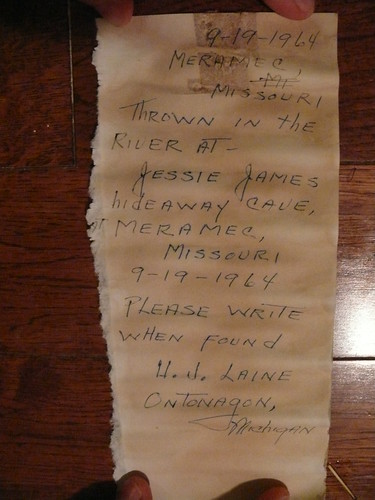
The message inside reads:  “9-19-1964.  Meramec, Missouri.  Thrown in the river at Jesses James hideaway cave, Meramec, Missouri 9-19-1964.  Please write when found.  H.J. Laine, Ontonagon, Michigan”
There is a picture of how I found it (a beautiful green glass bottle surrounded by snow). 


Found by Melanie Cheney, Assistant Program Manager with Missouri River Relief, February 15, 2014 at 5664 Meramec Bottom Road • St. Louis, MO 63128 during a clean-up dubbed "the Untouched Floodplain since 1993 Cleanup" organized by the “Arnold Stream Team 211”.

Missouri River Relief is Stream Team #1875, and as such has developed working relationships with many like-minded organizations and Stream Teams across the state working on river clean-ups for the past 14 years. 

Who is Missouri River Relief?  Missouri River Relief is a community & equipment based, not-for-profit organization dedicated to connecting people to the Missouri River through hands-on river clean-ups, education events & stewardship activities.  In its fourteen years of operation, Missouri River Relief has expanded its reach to more than 800 miles of the Missouri River, organizing events in communities stretching from Yankton, South Dakota all the way down to the confluence with the Mississippi River in St. Louis.  Since 2001, we have organized 133 river clean-ups utilizing more than 20,000 volunteers, and removing more than 800 tons of trash (a million and a half pounds!) from the river.

In addition to organizing our own clean-ups, we travel with our boats & equipment to other people’s clean-ups, resulting in over 70 “Away Teams” we've participated in throughout the years.

The Arnold Stream Team 211 members are a very special group.  We refer to them as the “Arnold Animals” because they are one of the toughest and most dedicated volunteer Stream Teams in the state.  Every weekend, two guys in particular are out working on streams, dumps, water quality monitoring and mapping.  A tire dump with 1,000 tires?  No problem for the “Arnold Animals”.  They will bring or get whatever resources are needed to get the job done.   As we developed a relationship with these guys, namely, Brian Waldrop and Bernie Arnold from Arnold, MO they began coming to our clean-ups, and in turn, if they are organizing a clean-up, a few of us try to come to theirs. 
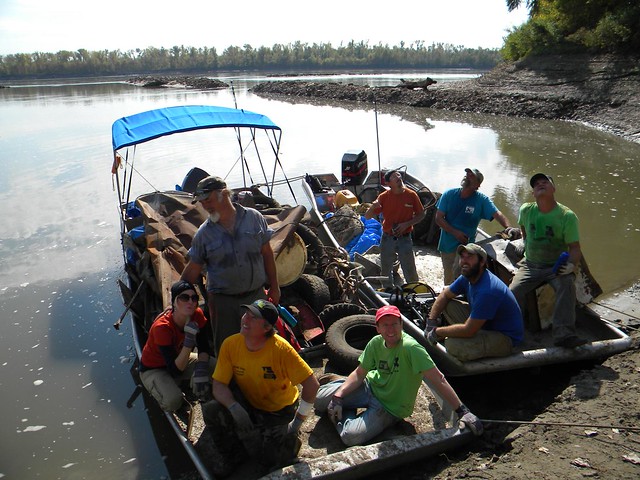
211/MRR Classic Rock Star pose

So that is how a few of us River Relief’ers found ourselves in the Meramec Bottoms on a frgid February morning  Even though there was still a little snow on the ground, and temperatures would barely reach above freezing, no way the “211” was backing off or canceling this event. 

What intrigued me most was the “untouched floodplain” part of the clean-up.  Whereas I am usually driving volunteers around on the Big Muddy in a boat, and picking up tons of “single-use” plastic bottles, this was a chance for me to romp around the woods, finding unique and very old treasures for River Relief’s future “Trash Museum” (We have been collecting stuff for awhile now and have found just about anything you could imagine out there).  Finding treasures is actually one of the best things about picking up trash.  You just never know what you’re going to find, some scary looking baby doll head or kids toy, a piano, a sign that simply says “Be Courteous”.  Often times, someone will find a message in a bottle.  But never one from 1964!  I believe this is the oldest message in a bottle we have ever found, and by far the coolest!

After working for a good part of the day, my friend Laurie aka “Ready” Ferretti and I took off through the woods to go check out some of the ruins that had been left in this forgotten floodplain.  There was an old truck, and lots of foundations from houses that once stood there.  We were searching for the “stairway to nowhere” of which we found and took some pictures on.  After we found the stairs, we saw a really cool looking foundation further back, with the chimney standing tall.  It was here that we were hanging out and exploring, (I was thinking that this would be the greatest playground ever for a bunch of  kids growing up here) that I looked down to see the green bottle peeking out of the snow, clearly with a message rolled up neatly inside. 

I was so excited!!!  I took a picture of how it was found before I even picked it up.  I also waited until I got home that night to open it.  When I read the message I couldn’t believe it.  Who was this guy from Ontonogan Michigan?  There was still tons of other bottles & trash that did not get cleaned up that day, I walked by many bottles at the end of the day as far as the eye could see, it was just amazing to me that I stumbled up this one amazing treasure.

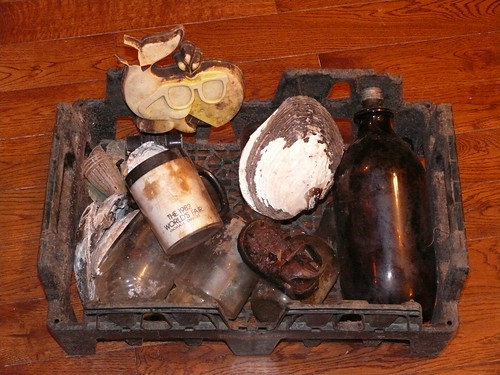
Some of the other treasures I collected that day included a plastic mug from the 1982 World’s Fair, a baby sandal, a plastic whale and some really cool old glass bottles, pictured here:

The Arnold Stream Team 211 recruited me with their facebook event page found here: https://www.facebook.com/events/579393298812290/

Here was their description of the event:  “This cleanup needs everyone's help. This land has been collecting trash since the Great Flood of 1993. There are 1000's of tires, hundreds of 50 gallon barrels, 3 boats, hot tubs, fuel-oil tanks, camper-shells, and a whole bunch of litter and trash. In some areas, you can walk across the trash without touching the ground. Yes, it is that bad.

This will be a two day cleanup, and still will not complete with this area. This will be a ongoing project for years, but we can make a large dent in the trash. With this amount of tires and barrels, the mosquito population is completely out of whack.

We will be having food on Saturday around the Noon hour and be parking in a small area past Butler Lakes and at Butler Lakes, then walking in to the site. Multiple dumpsters will be needed for this one.

**Look for the Stream Team Signs**

We could use ATV's and a Bobcat if you have them, possible with a trailer or two. This is also a good opportunity for Community Service for Scouts, church/school groups.”

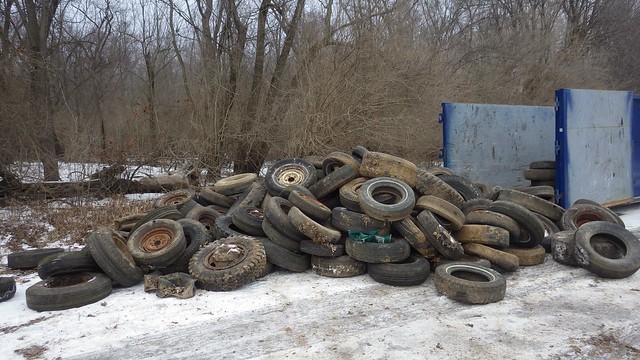
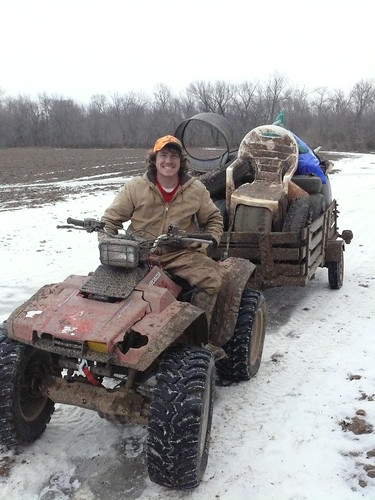
It turned out to be a really successful clean-up, with a one 40 cubic yard dumpster crammed full of trash, plus many plastic and metal 55gallon drums kept out of the trash dumpster. Now, for the tires, we filled one dumpster with 27 passenger tires, 12 tractor trailer tires, 255 tires with rims and a whole pile of tires that still need to be loaded up in trailers on Monday.  Just incredible the work these volunteers are doing.

River Clean-ups accomplish a few things effectively:  they engage people proactively in stewardship of our water ways, often getting people out on the river for the first time.  They also educate people about the problem of solid waste on our streams and rivers and physically bring interested parties together to accomplish something real.  We don’t have to tell people how bad “single-use” items like plastic water bottles are for the environment – we show them.  Clean water is something I think we can all agree on, it is quality of life.  And we are proud to be a part of Missouri’s Stream Team program, of which there are nearly 5,000 in the state looking after and taking action on our waterways. 

Anyone interested in learning more about Missouri River Relief should check out the website at: www.riverrelief.org.  To connect with other Stream Teams or to sign-up for one yourself, check out www.mostreamteam.org.

More on the message:  In the month following the finding of the message, a friend of a friend who writes for the River Hills Traveler and saw my photos on Facebook did some digging on the source of the message.  Here is what she found:

For 50 years, the bright green glass bottle survived the worst the Meramec
River could throw at it. Ontonagon is a town of 1,500 people, many of Finnish
descent, who migrated to the Upper Peninsula of Michigan to mine iron
or copper.

In a town of that size, surely someone would know something. Several
evenings of internet sleuthing proved futile. We’ve forwarded a digital copy
of this note to the historical society in Ontonagon, and to the genealogical
society. So far, no answers.

Cheney sent a digital copy of the message to Traveler, which we forwarded
to Maureen Guseck, editor of the weekly Ontonagon Herald. She agreed
to run an item in her paper.

Within a week we found out that a Mr. Uuno J. Laine was buried in the
Riverside Cemetery. Looking at the message again-- yes the first letter was
a squared off U, not an H. Born 1911, died 1973 in Ventura, California.
Morrison-Knudsen no longer exists, but used to be a construction engineering
firm.

We’ve got a few more fishing lines out, still seeking more info on the author
of the message in the bottle, which miraculously survived 100 miles and
50 years, just to be found, and in the finding, create more questions than had
it stayed entirely obscure.

June 7, 2012

A Soggy Saturday in St. Charles

 Mission: Clean Stream - Missouri River Clean-up Site
Bishop's Landing at the Lewis & Clark Boathouse
April 14-16, 2012
text by Steve Schnarr, photos by Brian Waldrop & Steve Schnarr
For our full results page with lots of links and info, go to: 
 
Mission: Clean Stream is one of the biggest single-day stream clean-ups in the state. Which is saying a lot considering there are over 4,000 Stream Teams in the state. The clean-up is hosted by the Greenway Network and organized by over 20 different municipalities, stream teams and other groups.

Mission: Clean Stream St. Charles Clean-up 4-14-12
For the first time, we turned our St. Charles clean-up into one of the sites at Mission: Clean Stream. So we decided to set up camp at the Lewis and Clark Boathouse and make a long clean-up weekend out of it. In addition to the Saturday Clean Stream clean-up, we decided to make another run on Sunday, then work with a group of REI employees on Monday afternoon.

10 people and 2 hours fills a boat.
This time we were lucky – we had the pros volunteering for us the whole weekend. Daniel and Jodi, part of our crew last fall, were both free for the whole shebang. We wouldn’t have Melanie on board, so that was a huge help. So we decided to head up Thursday evening, strike a quick camp and get ready for set up on Friday morning.

Friday morning we began to set up our kitchen, the Flying Nun tent. The wind was picking up and a quick glance at the radar revealed we only had a few minutes before the storm was going to arrive. Just as we were ready to string up the ropes and could use another hand, Jeff Barrow arrived from a meeting. We tightened it all up, then the pouring rain began. It continued through lunch and just began to slacken as we started the scout. But unfortunately it didn’t stop. That evening was the first in a string of soggy nights.

We were able to get a lot of morning chores done in between windows of rain, but pretty soon the rain set in, just as the first cleanup volunteers began to arrive.

Now River Relief has a “rain or shine” policy in general. Of course, if there’s lightning, then everything has to come to a stop. But if we cancelled a clean-up every time someone said it might rain, or because it was raining, we’d never get as much done. The volunteers who show up in the rain are always the most amazing people and just want to get out there and do it. We stress that everyone takes their time. Slippery boats and banks are real, but we can do this safely if we’re steady and smart.

Mission: Clean Stream St. Charles Clean-up 4-14-12
As the morning progressed, all of our partner boat drivers had to cancel. Which was the smart thing to do. We had less volunteers than we anticipated and to haul a boat through a storm to just wait and see what happened wasn’t a smart use of their time. But we were there already.

So we hunkered down for a bit then came up with a plan. The radar showed this wave of storms was passing through. As soon as the lightning had quit for a safe amount of time, volunteers broke into groups and scoured the forest and stream next to the parking lot. As soon as we could safely move our boats into position, everyone could filter down the ramp and hop aboard to hit a river site.

It turned out we had around half of the volunteers we’d anticipated. Every other Mission: Clean Stream site cancelled. But as soon as the lightning passed, the rain let up and a lot of hard clean-up work got done. Not that it completely stopped raining. But by then we could hardly notice or care.

Mission: Clean Stream St. Charles Clean-up 4-14-12
Greg Poleski from Greenway Network took his car to several nearby accesses and filled it to the brim with junk. After guiding a group of volunteers on the river, Bernie and Brian filled Bernie’s truck bed with junk recovered from the woods adjacent the Ameristar Casino. A bunch of Ameristar employees cleaned up all of the woods and sandbars between the I-70 bridge and the casino.


Lindbergh high school students cleaned up some nasty dumps under the 370 bridge. Jeanie Kuntz cleaned every tiny scrap of plastic from the beach at clean-up headquarters. We even got the militant paddler Big Muddy Mike Clark to get out in a motor boat and haul trash! (just kidding…not his first time) Jodi and Allison began recycling all the trash as it came in. They were joined by Geoff Janovsky, the recycling coordinator at Webster U.

Mission: Clean Stream St. Charles Clean-up 4-14-12
We ended up trailering the boats full of trash and dragging them from Blanchette Landing to our clean-up headquarters where everything got sorted for recyclables. Allied Waste donated the dumpsters, one for scrap metal, one for trash and one for recyclables. Each year they add more to their list of what they recycle, and this time it was a good percentage of stuff.

It was a tough, soggy day, but everyone worked with smiles and pride. We smoothed out the speed bumps and made an impressive haul for a group of 70 volunteers.

Our crew retired to camp after packing up what we could. Trailhead Brewery donated a complete dinner to us, with pulled pork, chicken, chili and great sides. The rain stopped and we got a fire going.

All of sudden it was a beautiful, pleasant and warm afternoon. I guess some of us felt like we deserved it!

On Sunday, a crew of folks, including the Arnold Stream Team 211 boys, stuck around for another trash haul. We’d heard there were a few tires to get under the railroad bridge. Well sure enough, as soon as we got under there, Bernie discovered a whole dump with 33 tires. And some shingles, carpet, a bathtub and other junk. We made a riverside stash of junk and swung the boat around to pick it up. Found another bathtub stuck in the riverbank and Bernie and Jeff wriggled it out.

Mission: Clean Stream St. Charles Clean-up 4-14-12
Bernie graciously offered to take the tires and add them to the 211’s stash (they collect enough tires to fill a tractor trailer then recycle them all at once).

That evening, the storms returned. We still had a strong, but small crew left, and we headed to old St. Charles for a hot dinner. It was an exhausting weekend, and the next day we’d be tearing it down.

The Flying Nun came down in the morning, and it turned into a gorgeous day. A bunch of REI employees, most of which had done clean-ups with us last fall during the Big Muddy Clean Sweep, came out for the afternoon and we were able to hit a couple of sites we missed both last year and during the Mission: Clean Stream. These folks already knew what to do, and they fanned out into the woods, consolidating all the trash they found and teaming up to haul it to shore. We completely filled one boat in just about an hour and a half.

As soon as we unloaded the last bag of garbage out of the boat into the dumpster, we were ready to head home. We have a reputation for bringing rain when we come to the St. Louis/ St. Charles area and this was no exception.

March 31, 2012

Cleaning up the Confluence!

4th Annual Confluence Trash Bash 2012
Columbia Bottom Conservation Area, Spanish Lake, MO
March 24, 2012
Rivermile 0-5 – River Stages: St Charles – 23.4 ft; Alton – 14.5; St. Louis – 19.5

Hosted by Confluence Partnership, St. Louis Metropolitan Sewer District, St. Louis Audubon, Arnold Stream Team 211, Grace Hill Americorps, Piasa Palisades Sierra Club and a bunch of other businesses, municipalities and organizations

text by Steve Schnarr, photos by John Ruskey and Melanie Cheney, paintings by John Ruskey

We finally got one. After three years of flooding and miserable cold/rainy/snowy weather, this year the Trash Bash landed on a glorious spring weekend. You can’t help but feeling unsettled by the mild winter and early, uniformly beautiful spring. But you also can’t help but get out and enjoy it.

Every year, we keep the option of camping somewhere down at the Confluence for this event, but cold and rain keeps putting us up in cheap hotel rooms. This time, we hooked up with our friends at Big Muddy Adventures (on an adventure that will be described later) and set up camp on the tail end of Duck Island, tucked on the Missouri side of the Mississippi River just downstream of the Confluence. After scouting our sites for the next day’s cleanup, we landed on the island only to be greeted by a beautiful rainbow.
4th annual Confluence Trash Bash 3-24-12
Our Duck Island Camp. photo by John Ruskey
Our part of the Trash Bash is to take a group of volunteers out on the river in boats to clean up the Confluence itself.  Being blessed with perfect weather this time, we were able to go a little further than in Trash Bashes past, actually getting the St. Louis side of the Confluence as well as the mouth of Coldwater Creek, a major urban tributary entering the Missouri at Fort Bellefontaine Park. We were joined this year by two Army Corps of Engineers biologists Megan Kerrick & Ben McGuire and their boat.

Other sites in the Trash Bash include North Riverfront Park, sites along the Maline, Watkins and Coldwater Creeks, some areas on Chouteau Island on the Illinois side, Creve Coeur Lake Park and a massive tire dump on Fee Fee Creek.

Melanie was leading a site along Maline Creek, so she and I headed to the Old Chain of Rocks Bridge where all the NW St. Louis sites were meeting. We gathered our crews together, did a safety talk then headed to our sites.

4th annual Confluence Trash Bash 3-24-12
Melanie's Crew on Site 12 on the Maline. photo by Melanie Cheney
4th annual Confluence Trash Bash 3-24-12Half our our volunteers were from the Washington University Alpha Phi Omega Service Fraternity. Great kids from a great organization. APO chapters across the state come to help at our clean-ups, always bringing more than 20 folks out to make it happen.

We had a sizable River Relief crew, with even our buddy Mike Smith from Washington, MO, coming to help. Friends from Missouri American Water, Boeing and Biomerieux showed up and we hit the river. All in all, we had 50 volunteers at our site, hitting three four different locations.

Because we had done a really big cleanup last year, this time we focused on spots missed last fall. There was plenty of trash to be hauled out of there, and couldn’t be a more beautiful day to do it.
Volunteers roll countless tires from the floodplain. photo courtesy Arnold Stream Team 211

The best thing about the Trash Bash is that you get to see the impact made in your area, but simultaneously there are groups all over the region making a similar or even greater impact. Our friends with Arnold Stream Team 211 gathered a team of really hard workers to remove tires from the floodplain along Fee Fee Creek. Our board member Francis Baum joined in the effort. These tires are thought to have been scattered from a landfill during a past flood and have been flooded several times since, scattering the tires throughout the riparian forest. This will be a project that takes several massive efforts.

A really great lunch was served up by Confluence Partnership, and then we hit the river again to haul all that trash in. Everything was loaded in boats, which were then trailered and hauled up to the dumpster. We hauled scrap metal and tires back to the Chain of Rocks Bridge to be added to the huge piles there. Including a massive metal tank of some kind dug out of the bank at Columbia Bottom which needed about six people to move.

4th annual Confluence Trash Bash 3-24-12
Trash is unloaded from the trailered boat into a dumpster. photo by Melanie Cheney
After we cleaned up the ramp, we headed out to the Confluence to drift among the swirling junction of the continent’s two longest rivers. The Missouri was cresting, and was pushing huge swirls of muddy water far out into the Mississippi. Massive flocks of cormorants streamed above as we were tossed about in the eddies. We drifted down the Mississippi side of Duck Island, viewing the eagle nest there from afar to not disturb the nesting couple there.

Eventually we ran into John Ruskey and Mark Peoples filling one of their Bell canoes with driftwood. It was their second load and they had moved our campfire down to the sandy point of Duck Island. We parked in a foamy eddy at the point and gathered for a some serious river time with a group of our favorite river lovers. Some lunch leftovers were donated to our camp and were supplemented with healthy snacks. Everyone took turns wandering the island and a driftwood bonfire drew everyone in. Ominous clouds gave way to a beautiful sunset. Cleanup organizers Natalie Johnson and Laura Cohen got ferried over for a moment of relaxation after the firestorm of 750 volunteers.
4th annual Confluence Trash Bash 3-24-12
The sun sets over the Mississippi River and a forest of planted driftwood. photo by Melanie Cheney.

After nightfall, we set up a projector and screen (with a generator tucked far away behind a sandbank) and watched a film about John Ruskey’s adventures last year riding the crest of the Great Flood of 2011 through the state of Mississippi. With a backdrop of the river itself, this film festival had the venue down!

Another short film we watched was about the Circumnavigation of St. Louis. This is the expedition that the Big Muddy Adventures Crew is still doing. Big Muddy Mike Clark, Driftwood Johnny Ruskey and Mark “Rivers” Peoples, “Queen Bee” Betsy Tribble and David Hanson from Seattle were working their way up the Mississippi River in light glass canoes. Their journey had started at the confluence of the Bourbouse and Meremec Rivers, scribing a circle around the greater St. Louis metropolitan area on a highway of rivers.

After pausing at Duck Island for a day, taking a group of Trash Bashers to the island by canoe to remove trash, they would be heading around the Confluence and 70 miles up the Big Muddy. Their virtual passengers were from 7 grades of St. Ann’s of Normandy School, following their adventures online and researching their own topics related to the trip. I’d be joining them Sunday morning, just as David Hanson was getting off and heading back home.
The Circumnavigation Crew heads upstream toward the 367 bridge. photo by John Ruskey

You can read all their expedition journals, check out their amazing photographs, view John Ruskey’s watercolors and see the postings of St. Ann student at the Big Muddy Adventures Schoolhouse Blog.

Around 11 on Sunday, our River Relief crew had packed up and headed to shore. I hopped in a canoe with Mike and Betsy and up we paddled. I stayed on for two days, getting up to St. Charles. It was a powerful and humbling experience, and I hurt for days after. These guys kept going to Washington, MO, 68 miles up the Missouri. From there they would be portaging their canoe overland for 10 miles to hook up with the Bourbouse and finish their trip around St. Louis with a brisk downstream float.

John Ruskey's watercolor of the Circumnavigation (in dark blue). 


John Ruskey watercolor of a side chute on the Missouri River.


September 28, 2010

a weekend in the little hills

St. Charles Missouri River Clean-up
Bishop's Landing at the Lewis & Clark BoatHouse
Sept. 10-12, 2010
text by Steve Schnarr, photos by Alicia Pigg, Tom Ball, Vicki Richmond, Penningtons, others?
for more on this event, see our event page:
http://www.riverrelief.org/event/st-charles-missouri-river-clean-up-2010/

As we were preparing for dinner on the banks of the Missouri River in St. Charles, a lone kayaker pulled his boat up the abandoned boat ramp by Lewis and Clark BoatHouse and started unloading gear.

It turns out, this was Tom (never caught his last name) who had started paddling at Three Forks, Montana, where the Jefferson, Madison and Gallatin Rivers join to form the Missouri. He had started in May.

We invited him to dinner and to camp with us, under the shadow of the BoatHouse. The idea of a cold beer seemed like a really good one to Tom. He politely took a barrage of questions from our crew, laughed and shared stories.

And he had a funny observation. “As I was paddling downstream, all of a sudden I saw these blue bags laying on shore. At first I was kind of pissed and thought about pulling over and picking them up,” he said. “After seeing several, I started to realize this was probably part of the clean-up”.

Tom had heard about the clean-up from “Big Muddy” Mike Clark, our friend and fellow river cleaner who has introduced many hundreds of people to the Missouri and Mississippi Rivers through his Big Muddy Adventures guide service. Tom had called Mike for advice, and he suggested that if he was coming through St. Charles on Sept. 10 or 11, he ought to find the River Relief crew if he wanted to sit around a campfire with some fellow river rats and swap stories.

Those blue bags are our “trash flags”. The day before a clean-up, an early crew heads to our campspot, sets up our “Flying Nun” kitchen tent, and sends out a couple of boats with trash bags, maps and a dispatcher. The crew’s job is to find the places where we can safely drop off volunteer crews the next day. To make it easy for the clean-up boat drivers to see those spots, we flag them with a big, blue Stream Team trash bag with a rock in it tossed on shore.

The dispatcher marks all these spots on a map with descriptions of how many people the spot can take, any special notes on finding the trash and what tools the crews will probably need. She divies the river reaches up into sections that can take several boatloads of volunteers and makes an individual map for each boat driver on the clean-up. This is a simple way to communicate to the boat drivers where to take volunteers. Ideally we cover 10 miles of river at a big clean-up – five miles up, five miles down.

Even though he was exhausted from his months of river travel, Tom fit right in with the crew the next day. The only way things work at an event like this is if the volunteer crew is proactive in seeing what needs to be done and getting it done. Tom was right there, hopping in wherever the action was. An instant crewmember.

This brings me to our crew. Missouri River Relief has a staff of three full-timers and two part-timers. Everyone else is a volunteer. Essentially what staff does is to organize a framework where our volunteer crew can step out of their busy lives and have a fun and productive weekend by making these events happen.

Without this base of unreasonably dedicated volunteers, nothing would get done. They give many, many weekends – and often Thursdays and Fridays – plus countless evenings and free time, to keep the machine rolling. They operate our boats, keep them maintained and working, and train new operators on safe and efficient river piloting. They plan camp menus and prepare amazing food for the crew. They offer ideas on improving our systems and then implement them. The degree of passion and care they give to even the smallest details is kind of stunning. Our biggest fear is burnout, so we try to keep things interesting and fun, and to always bring new people into the crew so the burden doesn’t fall on too few old-timers. It’s a tough balance, but so far it’s worked.

I have no idea how this thing keeps working – it seems like magic. What makes it tough to define is that the magic is held within many different, very special people. But it seems that the glue holding it together is a love for the river, a willingness to work hard and selflessly, and a love for each other.

People certainly ask me, “How do I get one of those crew shirts?” The only way I know to answer is to describe what River Relief crew does – travel all over the watershed doing the behind the scenes work that makes an event run smooth. Then I say, “It’s pretty much a personal decision. You decide that at this time in your life, you want to be part of the River Relief crew. And you email me and get on the crew list and when you can help, you come help.”

In St. Charles, and also the bigger Confluence area, we’ve been doing clean-ups since 2002. There’s a tribe of folks that always shows up for clean-ups in the area, and they form the base of our St. Lou crew. I don’t really know if these folks met through our events, around our campfires, or if they knew each other before because of their river-obsessed ways.

There’s Jim Denner, the anatomy teacher from Lindbergh High School. Every time we’re anywhere close, he brings 35 to 50 students – most of which have never been on the Missouri River before. This year there were two events close to St. Louis – in Washington in April and St. Charles this Sept. He brought kids to both. In Washington, the kids were in a hurry to get out of there after a morning of hard work, because that was their Prom Day…!

Tom Ball – a lifelong river educator and stream defender. He shows up when he can and leaves when he has to. From safety talk to tire wrangling to renditions of Neil Young around the campfire, it would be a sad clean-up if Tom didn’t show up. This time, he took the Fort Zumwalt Trashinators out on the river and showed 'em how it's done. That's him in the front there with the orange Americorps lifejacket.


Mighty 211 – this crew is Stream Team #211 from the Meremec River at Arnold. In St. Charles this year, Bernie Arnold and Laurie Fauretti both came to help. Bernie brought his tire trailer, worked the lifejacket pile then hopped on the river to haul in garbage. After working registration into shape, Laurie got lunch going then did the afternoon trash haul. At 211 clean-ups she usually helps organize the lunches and was glad for the chance to leave the food scene and hit the river. Boy do I know that feeling… going to someone else’s event and getting to do the actual work.

Craig Holt – Craig started showing up to River Relief clean-ups about five years ago. He’d usually come a day early, get his own camp set up, then be there to help every step of the way. I remember last time we had a big event at Columbia Bottoms and he showed up with a pot of stew when we arrived with no dinner plans. This time, Craig couldn’t get there ‘til Saturday morning. We actually had a ceremony to conjure up Craig the night before.

Craig on the left and Rod on the right load up Greg Dennigmann's bucket with river trash.
photo by Alicia Pigg.

Big Muddy Adventures – these guys are our true partners in the Confluence area. They are their own river clean-up crew, by canoe only. Mike Clark and Betsy Tribble show up with their Clipper Canoe (seats 12) and hit the river with big smiles whether they have a crew or not. Then proceed to fill that boat with trash on their way downstream. Betsy and Mike also take a group of students called the River Kids out in canoes once a month to clean up and experience the two mightiest rivers in the country: the Missouri and Mississippi.

This is the BMA crew at the Washington Clean-up in April. photo by one of those Penningtons

Lewis and Clark Boathouse – these folks are a fellow non-profit with a mission similar to ours. They bring people to the river, but they are focused on exposing folks to the amazing history we share tied in with this valley. This year, they let us camp in their front yard (“behind the boathouse”) next to the river. An amazing beach with a young riparian willow forest managed by the local Master Naturalists, some great fishing spots and a heirloom vegetable, herb and native plant garden. Behind us, the massive boat house and nature center was the dry dock for three gorgeous, handmade replicas of the fleet the Corps of Discovery took up the Missouri River in 1804. These boats made the same journey in 2004.

Francis Baum – this guy started his own environmental organization of fellow Boeing workers. BEEP – Boeing Employees for Environemental Protection. He travels across the state to help with River Relief events, and this time he took on the dispatch position – scouting the trash on Friday then sending folks out there to pick it up on Saturday morning. He was a little bummed this year that “Talk Like a Pirate Day” landed on the day after the clean-up….

Many other friends and familiar faces joined us on the riverfront that day. Along with over 250 other state-wide volunteers picking up trash, sorting out recyclables, piloting (and fixing) boats, teaching and learning, serving and being served, this group of local folks made this event happen.

Although everyone felt tired at the end of the day, no one felt broken. In fact, after a dinner graciously donated by Trailhead Brewing across the street and gathered around a campfire sharing stories, we all felt a little healed. I’m pretty sure we healed each other, and the river healed us all.

April 23, 2010

So...where does all that trash go after you pick it up from the river?

Washington River Festival & Missouri River Clean-up
Rennick Riverfront Park, Washington, MO,
April 17, 2010


text by Steve Schnarr, photos by Vicki Richmond & Tom Ball

"So...where does all that trash go after you pick it up from the river?"

I would say that's about the fourth most common question that gets asked from most folks curious about river clean-ups. Good reason, too! An amazing amount of junk gets recovered from the river during these clean-ups and most people would like to know it' getting put to good use. It's tough, but we try to recycle as much as we can...and hope to keep getting better.

My answer to the question usually starts with "Well, that depends on the community we're working in..." And each disposal solution usually has its own story. Here's some from the Washington Clean-up...

River Trash to Art
In three years, volunteers have removed over 40 tons of junk from a very old dump on the Osage River near the Mari-Osa ramp. We’ve bemoaned the fact that all this interesting stuff just got scrapped, except the treasures volunteers took home with them. This year, the Washington River Festival gave us a chance to do something with it.

A month ago, I delivered a couple big trash cans full of select Mari-Osa trash (culled by Ruthie Moccia) to Joey Los, a metal sculptor from Hermann that is co-owner of Kunstlerhaus gallery. Joey has been working with the Greenway Network’s Stream Trash to Art program, donating her time and work to creating beautiful and interesting sculptures from trash found on stream clean-ups. She, and several other artists offered to set up shop at the festival with welding equipment to make art from our Mari-Osa trash, and anything interesting that came off the river during our Washington clean-up.

Larry Pogue, whose impressive gallery is located on Front St just across the train-tracks from the Washington boat ramp, cranked out unbelievable standing sculptures of fish and flowers. Patrick McCarty worked with the Waggoner boys from Greenway Network to make creations using an old-style blacksmith oven.

Then, they donated all of these works to an auction raising money to help pay for the clean-up. Jean Ponzi from KDHX 88.1 was the auctioneer, and with the generous bids of festival goers, everyone raised over $1,200 for Missouri River Relief! Thanks to all of you for your creativity, generosity and hard work!

River Trash to Timber
The most common material we find on clean-ups is plastic. Plastic bottles, coolers, oil and antifreeze jugs, toys, plant pots, playground equipment, balls. Plastic generally floats pretty well, moves easily down streams during high water and gets deposited in drifts along the floodplain of the Missouri River.

River-ravaged plastic is often either full of mud and sand or coated in it. Most recyclers don’t want to deal with it. The sediment dulls their grinding blades, and contaminates the final product. It would be cool if we had our own grinder and some kind of washing system (using biodegradable cleaners and using little water), but we don’t. So if a recycler is willing to take the stuff, they usually have to re-sort the load to get only the plastic they want.

So far, we’ve worked with Civic Recycling in mid-Missouri and Coca-Cola Enterprises in Kansas City to recycle river plastic. Our friend Billy Froeschner, from Sustain Mizzou, told us about his friend, Gary Ryan, who owns Ryan Enterprises and turns a variety of plastics into fence posts and landscape timbers. Billy offered to bring his gooseneck horse trailer to Washington to haul away the plastic, and he even set up the recycling station.

The frantic sorting scene drew a lot of spectators from the River Festival – and some looks of amazement at what was actually in those blue bags coming off the river. Well, all that hard work recovered an estimated 750 pound of plastic - half of that horse trailer full!

Heavy Lifting
Just getting the trash off the boats and where it needs to be is a big task, best handled by a front-end loader or skid steer. Randy Thiemann from the Washington Parks and Rec. Dept. gave his Saturday up to hauling trash from the boats to the recycling station or the metal truck. He rolled up just as the first mud-filled refrigerator came up in a boat and we were scratching our heads on where to put it. Right up to the end, where he blew a hydraulic line on the second to last boat load of junk, he worked that ramp hard. The Parks Dept. also paid for the landfill dumpster supplied by Beck Disposal from St. Louis.

Tires are always the problem…
We had trouble finding someone to haul tires to a recycler for this event. Finally, the week before the event, our crewmember Bernie Arnold from Arnold, MO, offered to do the hauling for us with his big, walled trailer. He bought the trailer to help get rid of the massive numbers of tires that Stream Team 211 finds on the Meremec River, and here he was jumping out of his watershed to help us out in a pinch. The 85 tires recovered went to Tire Shredders Unlimited in High Ridge, MO, which creates a rubber “crumb” that is used in playgrounds, horse arenas and as an additive to coal to burn hotter and cleaner creating electricity.

Scrap Metal
This stuff is actually worth money! Sometimes, we make quite a lot of cash from the scrap metal. Other times, it’s much easier to let a local scrapper to pull up a trailer or dump truck and let them take it away. This time, Franklin Co. Recycling brought a dump truck, and we filled it to the brim - 3.9 tons! There’s a lot usable metal you can get from 15 miles of river!