Showing posts with label Rocheport MO. Show all posts

May 14, 2012

On the River with Douglass High School

 photos and text by Steve Schnarr
click here to check out photos from past Douglass river trips. 

John Reid crop
John Reid at the Manitou Bluffs
We’ve been taking Missouri River trips with John Reid’s students for four years. Mr. Reid, as his students of course call him, is not your average teacher. And the kids that come along with him on these river adventures are not your average student.
John works at Douglass High School in Columbia.

He started a “Service Club” at Douglass, where he creates opportunities for his students to work with local nonprofits, and to generally get out in the community and make it better through creek clean-ups, community gardening and ecosystem restoration projects. Four years ago, it was the Service Club that hopped on our boats after class for a quick river tour.

Among other subjects, John teaches Environmental Science. So a couple of years ago we started taking some of his Environmental Science students out on the river in the morning, and the Service Club in the afternoon, during school hours.

We get to work with the students that want to come, and put forth the extra effort to make the trip. John makes it easy for them, and everyone gets a pair of mud boots so they have no excuse not to get out of the boat and check things out.
Douglass High School Service Learning River Trips 5-3-12
The Morning Crew - Environmental Science Class
The first group of students that walked down the boat ramp were from the Environmental Science class. None of these kids had been with us on a river trip, and only one of them had been on the Missouri River before. As they walked down the ramp, they made comments like “We’re not getting in that boat” “I’m not going out on that river” “What if we fall in” and “I’ll just wait here on shore”.

After they got their safety talk (interspersed with comments like “What! I’m not going to be in a boat with no fish that big jumping in!”), though, they all eagerly hopped on the boat. It was obvious that, even with all the bluster, they completely trusted Mr. Reid. Half were lobbying for us to go fast with the other half shaking their heads.

The second group, from the Service Club, were a more adventurous lot from the start, used to Mr. Reid taking them outside of their comfort zones.
Douglass High School Service Learning River Trips 5-3-12
The Douglass High School Service Club cleans up the river. photo by Steve Schnarr

We show them the recreated Tadpole Island, where the Army Corps of Engineers dug a new chute across the river from Huntsdale. Before the river was channelized there was an island there called Tadpole Island, and now it exists again, ringed with sandbars.

A bit further upstream is an eagle nest. In May, when our spring trip usually happens, the babies are beginning to stand up in the nest and test their wings. One of the parents sits in a tree nearby watching.

On our first trip this year, none of the kids aboard had seen a bald eagle before. They loved it and couldn’t believe the size of the nest. “Who made that nest for them?” “How did they make a nest so big?”.

We discuss the near collapse and latest success of the bald eagle. About how DDT nearly wiped them out, just because it made their eggs too fragile. And now you can find a bald eagle nest about every 10 or 15 miles on the Missouri River.

If we have time, we motor on upstream past the Manitou Bluffs to I-70. Most of the kids had been on this bridge on their way to Kansas City. They mention how the river seems so much closer from the bridge. We feel tiny in our boat motoring past bridge piers swirling in the current.

We shut off the motor and drift under the massive trusses, checking out the cliff swallow nests tucked underneath, little clay jugs stacked up like apartments. Tucked into the bluff just next to the bridge is a cave mouth swarming with swallows. It’s easy to talk about how those bluffs were where the swallows naturally would build their nests, but the bridges work fine too.

Drifting back downstream, we come to Lewis and Clark Cave. Previously called Torbett Spring, this cave is now tucked behind the Katy Trail, with its spring waterfall emerging from a railroad culvert dated 1904 and tumbling down rip rap into the river. Meriwether Lewis noted the cave in his journal, with little drawings to depict the Native American petroglyphs painted on the bluff above the cave. 

We show the kids the remnants of the paintings that are left. “A “Nike Swoosh” with a dot above it,” is how Mr. Reid describes it, and the kids see it right away.
Daniel with Tire
Daniel drags a tire from the rack pile.

If we have time, we explore the mouth of the cave (the interior of the cave is closed to the public to protect Indiana bat nurseries), but today we are running out of time. We need to move onto the clean-up.

Morning and afternoon groups each get a different beach. This year, after last year’s high water, we clean up areas where driftwood has collected on the high banks. Balls, tires, plastic bottles, toys…all the usual suspects are there. The kids fill bags quickly, and help each other carry them across the wood piles. At first they’re bummed that they get some mud on their pants, but that disappears immediately.

They’re amazed at the trash they find out there.
Douglass High School Service Learning River Trips 5-3-12
Service Club scours the driftwood for trash.

Map Turtle laying eggs on a sandbar near Rocheport. We saw a turtle laying eggs in the sand. A group of deer getting a drink by the water. We stomped in quicksand. Buzzards flew overhead in a cyclone.

Just another day on the river.

One group got two and a half hours…the other only two.

Mr Reid and his refrigerator
Mr. Reid and his fridge.
We see a refrigerator floating next to the bank. With just a few minutes left in the trip, we decide to see if we can get it in the boat. One student, Daniel, and I got in the bow of the boat, with John Reid trying to push the fridge from shore. It seemed impossibly heavy, but with Daniel using a shovel to pry underneath and me lifting a corner of the fridge, we got one edge up on the bow. Then it became much easier and we shifted the fridge into the boat. Everyone on board was proud.

Douglass High School Service Learning River Trips 5-3-12 And by the time we got back to shore, they were old river pros. “We saw eagles, Mr. Reid.” One student laughs at the mud on his friends shoes. “What are you gonna tell people about all that mud on you?” “I’ll tell ‘em I’ve been hanging on the Missouri River YO!”

This past winter we came up with a new award to give. To the teacher that really stepped up and helped us get kids on the river for a real experience. We decided to call it the “Floating Classroom Award” and we gave it to John Reid. In fact we were able to give it to him at our screening of the Wild & Scenic Film Festival in the Blue Note in Columbia.

With the support of his school’s administration, John makes amazing efforts to get these kids out of the classroom and into the natural world and their community. Teachers like this are absolutely priceless.

Who will get the “Floating Classroom” this year?

January 12, 2010

When the Big Muddy Turns White

Frazil Pans and Border Ice
by Steve Schnarr
photos by Steve Schnarr and Brian Waldrop

The question always comes up when you're sitting on the riverbank in winter, watching and listening to the ice flow by. "I wonder where that ice comes from?" We try to imagine what event, what special place or kind of place was creating all this ice then shooting it down the river at us.

From what I gather, most of it is created everywhere in the river (where it's below freezing). Most of the ice is called frazil (or frazzle) ice. It is formed when small, needle-like ice crystals actually form in or on the surface of the water as turbulence in the river causes some of the water to become supercooled, or just below freezing. These ice slivers begin to stick together, creating a slush. The current gathers the slush together and the frazil pieces begin to freeze to each other. The tumbling action of the current and of slush blocks hitting each other and rolling off the banks forms these circular "pancake ice" or "frazil pans". We call 'em ice floes.

It's sort of like the river is so cold it oozes slush, which floats to the top and paints this ever melting, ever freezing, always changing floating sculpture.

On very cold days, near zero, delicate frazil structures can build up on the pans. As pans bump into each other, they may tilt up, then freeze to another pan, creating some of the towering iceberg structures.

On the Missouri, one of the most interesting things to me is how the ice appears white, despite the turbidity of the water.

Looking down from Boonville Bridge. photo by Brian Waldrop.

Another ice formation you might see are large sheets of ice that break out of tributaries or in the eddies along the side of the river. If there is frozen border ice along the river and the river drops or rises dramatically, these sheets will break loose and go on down the river.

I've seen some as large as a row of barges. Awesome.

Blogmaster Note - Several years after this was posted, a Columbian Missourian reporter saw it and decided to write an article, interviewing several of my friends. "The Science behind Ice on the Missouri River" by Christopher Aiken, Jan. 16, 2015.

Here's a link to some basic river ice facts from the Army Corps of Engineers

Check out this super cool video we put together from time lapse photos of the frozen Missouri River near Boonville, MO. Soundtrack by David Dearnley (https://www.reverbnation.com/daviddearnley)

May 1, 2009

Rocheport Trash Tally!

Rocheport Bend Day of Caring
April 18, 2009
Rocheport, MO, and Overton Bottoms Unit of Big Muddy Refuge


Here's some results and a trash tally from this amazing day!

Thanks to everyone that made it happen...

Total Volunteers: 133 (73 clean-up volunteers)
MRR Crew: 32
Boats: 4 (3 Missouri River Relief; 1 Mo. Dept. of Conservation)
Stream Teams: The Mighty 211, 549, 1875, 1876, 2489, 2793
Rivermiles: 2
River level: 10.8 (Boonville gage)
Scrap Tons: 1 ton
Landfill Tons: 3 tons
Tires: 111 (est. 1.7 tons)
Total Tonnage: 5.7 tons
Bags of Garlic Mustard Pulled: 56 large bags
Trees Planted: 300 trees

Trash Tally!
More than 114 Large Stream Team Bags
111 Tires: 72 on the rim, 37 w/o rims, 1 truck tire, 2 inner tubes, 1 bicycle
4 Refrigerators
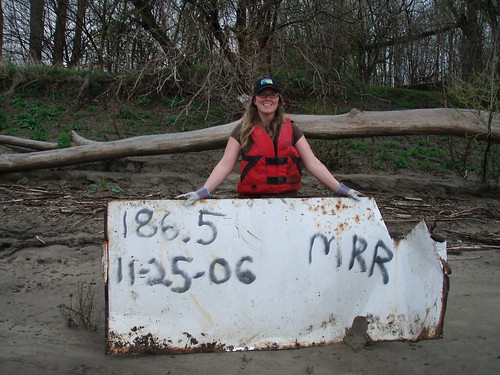
1 Chest Freezer in parts (tagged on 06 MegaScout trash survey)
1 Hot Water Heater
1 Dryer
5 Coolers
1 Bed Frames
4 Box Springs
5 Chairs
4 30-gallon Trash Cans
4 5-gallon Plastic Buckets
80 feet of 1” Poly Tubing
9 1-gallon Paint/Varnish Cans
10 feet of Garden Hose
10 feet of Plastic Piping
17 assorted Scrap Metal pieces
1 Hot Tub w/ Cover
1 Ironing Board
1 very ugly old woman rubber mask
1 Lock Pick Set
1 Lot Fence Wire
3 3-gallon Metal Buckets
1 Typewriter
3 55-gallon Metal Drums
1 Park Bench
1 Camping Table
1 Truck Bed Liner
1 Fire Extinguisher
1 Toilet
Several hundreds of pounds of roof shingles
1 Kitchen Sink
13 Mason Canning Jars

Jody Coats shows off a piece of a big freezer. photo by Scot Heidbrink

Gettin' it done in Rocheport

Rocheport Bend Day of Caring
April 18, 2009
Rocheport, MO, and Overton Bottoms Unit of Big Muddy Refuge

text by Steve Schnarr, photos by Scot Heidbrink & Melanie Cheney
check out our Rocheport Results webpage for more links & info

It all started with a commercial freezer. We came across this thing in 2006, when we were finishing off the home stretch on our MegaScout trash survey. During the previous summer and fall, we’d mapped trash on 754 miles of the Missouri, from Ponca, NE, to the Confluence north of St. Louis, MO. For thanksgiving weekend, we finished off the home stretch, from Boonville to Jeff City.

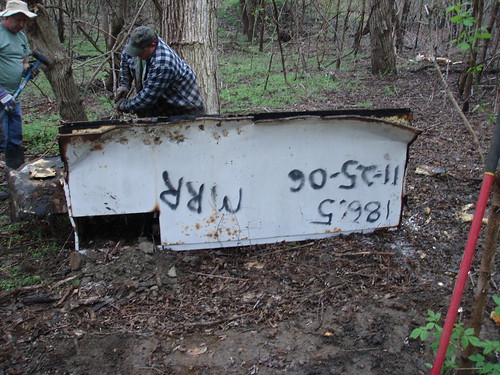
Racin’ Dave and I spotted a pile of tires and a big appliance. We GPS’d the spot (just upstream of Moniteau Creek next to Rocheport) and Racin’ spray-painted the rivermile and date on the side of the freezer lest it float away before we get it. (so far we’ve found several of these “tagged” items at clean-ups. The furthest travelled was 326 miles – click here to check out the blog post)

So when Missouri River Communities Network (MRCN) Vista member Maria Dorsey asked us if we wanted to add a clean-up component to their annual Rocheport Day of Caring on April 18, I immediately thought of that freezer. And all the trash along the Katy Trail and the tires scattered through the woods by many floods.

Soon, there was more. The Big Muddy Refuge across the river wanted volunteers to have a garlic mustard-pulling party, and that was the only weekend they could do it. So it became the Rocheport Bend Day of Caring – volunteer efforts spread on both sides of the river to improve the land.

Students from a West Junior High French Class gathered to plant 300 trees throughout city parks and along Moniteau Creek. This project was organized by Maria, then-Rocheport mayor Brett Dufur, and MRCN Americorps workers Katrina Thomas and Pam Venable. The Friends of Rocheport worked with us to put on lunch for the whole crew.

We decided to do a three-prong clean-up assault. One team worked on pulling down the remains of a collapsed building right along the Katy Trail. They bagged up the shingles and trash and left a monster burn pile ready to go. It took all morning with a chainsaw, a gas-powered chop saw, hammers, pry bars and shovels. Tires from the surrounding woods were rolled to the trail and bags of trash emerged from the surrounding forest.

Another several groups cleaned along the Katy Trail, walking deep into the forest and rolling out tires and all kinds of junk.

And some more folks hit the river, walking down the Riverwalk trail to the mouth of Moniteau Creek to meet the River Relief boat fleet. Boats took crews to the site of the aforementioned freezer, as well as a couple spots near the old head (now closed) of the Overton Chute.

The original Overton Chute had a sharp bend near its entrance, and quickly became clogged with driftwood. So the Corps of Engineers punched in a new entrance just
downstream. But driftwood and a whole lot of trash still collects in the old entrance (a spot Refuge Biologist Wedge Watkins told us about and flagged for us). Volunteers struggled through the driftwood, dragging bags full of plastic and glass and rolling refrigerators and tires to shore to be hauled away by boat.

Meanwhile, volunteers Don Doughtery (who drove to the cleanup in the rain in his cool go-cart) and Alvin Sweezer broke that freezer into manageable pieces that could be hauled to shore.

Even though this was a relatively small clean-up, it was one of our most complicated, with volunteers showing up at Rocheport and then walking 1/2 mile to board boats. Boats were launched across the river at Taylor's Landing, where trash was also hauled out. Plus, the overpass to Taylor's Landing was closed, meaning an extra 10 minute drive for hauling trash and boats by land.

So activity was buzzing all over the river that day, and a whole lot got accomplished. 300 trees were planted, 56 huge bags of garlic mustard were pulled, 111 tires were removed from town and the river, and 5.7 tons of trash were hauled away.

Thanks to everyone who came out on a soggy Saturday to help beautify the Rocheport Bend!!!!

Special thanks to Brett and Tawnee Dufur, who hosted our crew camp at their beautiful Katy Trail Bed and Bikefest, and made a bunch of other things easier.

Thanks to the City of Rocheport for contributing to our lunch and disposal costs.

And thanks to the Missouri Department of Natural Resources for funding Missouri River clean-ups.