May 1, 2009

Rocheport Trash Tally!

Rocheport Bend Day of Caring
April 18, 2009
Rocheport, MO, and Overton Bottoms Unit of Big Muddy Refuge


Here's some results and a trash tally from this amazing day!

Thanks to everyone that made it happen...

Total Volunteers: 133 (73 clean-up volunteers)
MRR Crew: 32
Boats: 4 (3 Missouri River Relief; 1 Mo. Dept. of Conservation)
Stream Teams: The Mighty 211, 549, 1875, 1876, 2489, 2793
Rivermiles: 2
River level: 10.8 (Boonville gage)
Scrap Tons: 1 ton
Landfill Tons: 3 tons
Tires: 111 (est. 1.7 tons)
Total Tonnage: 5.7 tons
Bags of Garlic Mustard Pulled: 56 large bags
Trees Planted: 300 trees

Trash Tally!
More than 114 Large Stream Team Bags
111 Tires: 72 on the rim, 37 w/o rims, 1 truck tire, 2 inner tubes, 1 bicycle
4 Refrigerators
1 Chest Freezer in parts (tagged on 06 MegaScout trash survey)
1 Hot Water Heater
1 Dryer
5 Coolers
1 Bed Frames
4 Box Springs
5 Chairs
4 30-gallon Trash Cans
4 5-gallon Plastic Buckets
80 feet of 1” Poly Tubing
9 1-gallon Paint/Varnish Cans
10 feet of Garden Hose
10 feet of Plastic Piping
17 assorted Scrap Metal pieces
1 Hot Tub w/ Cover
1 Ironing Board
1 very ugly old woman rubber mask
1 Lock Pick Set
1 Lot Fence Wire
3 3-gallon Metal Buckets
1 Typewriter
3 55-gallon Metal Drums
1 Park Bench
1 Camping Table
1 Truck Bed Liner
1 Fire Extinguisher
1 Toilet
Several hundreds of pounds of roof shingles
1 Kitchen Sink
13 Mason Canning Jars

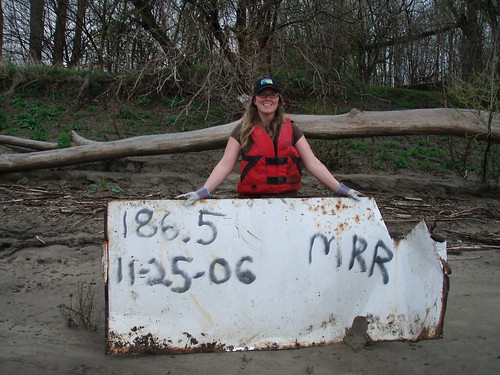
Jody Coats shows off a piece of a big freezer. photo by Scot Heidbrink

Gettin' it done in Rocheport

Rocheport Bend Day of Caring
April 18, 2009
Rocheport, MO, and Overton Bottoms Unit of Big Muddy Refuge

text by Steve Schnarr, photos by Scot Heidbrink & Melanie Cheney
check out our Rocheport Results webpage for more links & info

It all started with a commercial freezer. We came across this thing in 2006, when we were finishing off the home stretch on our MegaScout trash survey. During the previous summer and fall, we’d mapped trash on 754 miles of the Missouri, from Ponca, NE, to the Confluence north of St. Louis, MO. For thanksgiving weekend, we finished off the home stretch, from Boonville to Jeff City.

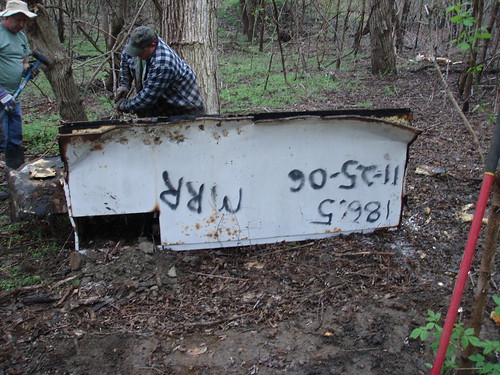
Racin’ Dave and I spotted a pile of tires and a big appliance. We GPS’d the spot (just upstream of Moniteau Creek next to Rocheport) and Racin’ spray-painted the rivermile and date on the side of the freezer lest it float away before we get it. (so far we’ve found several of these “tagged” items at clean-ups. The furthest travelled was 326 miles – click here to check out the blog post)

So when Missouri River Communities Network (MRCN) Vista member Maria Dorsey asked us if we wanted to add a clean-up component to their annual Rocheport Day of Caring on April 18, I immediately thought of that freezer. And all the trash along the Katy Trail and the tires scattered through the woods by many floods.

Soon, there was more. The Big Muddy Refuge across the river wanted volunteers to have a garlic mustard-pulling party, and that was the only weekend they could do it. So it became the Rocheport Bend Day of Caring – volunteer efforts spread on both sides of the river to improve the land.

Students from a West Junior High French Class gathered to plant 300 trees throughout city parks and along Moniteau Creek. This project was organized by Maria, then-Rocheport mayor Brett Dufur, and MRCN Americorps workers Katrina Thomas and Pam Venable. The Friends of Rocheport worked with us to put on lunch for the whole crew.

We decided to do a three-prong clean-up assault. One team worked on pulling down the remains of a collapsed building right along the Katy Trail. They bagged up the shingles and trash and left a monster burn pile ready to go. It took all morning with a chainsaw, a gas-powered chop saw, hammers, pry bars and shovels. Tires from the surrounding woods were rolled to the trail and bags of trash emerged from the surrounding forest.

Another several groups cleaned along the Katy Trail, walking deep into the forest and rolling out tires and all kinds of junk.

And some more folks hit the river, walking down the Riverwalk trail to the mouth of Moniteau Creek to meet the River Relief boat fleet. Boats took crews to the site of the aforementioned freezer, as well as a couple spots near the old head (now closed) of the Overton Chute.

The original Overton Chute had a sharp bend near its entrance, and quickly became clogged with driftwood. So the Corps of Engineers punched in a new entrance just
downstream. But driftwood and a whole lot of trash still collects in the old entrance (a spot Refuge Biologist Wedge Watkins told us about and flagged for us). Volunteers struggled through the driftwood, dragging bags full of plastic and glass and rolling refrigerators and tires to shore to be hauled away by boat.

Meanwhile, volunteers Don Doughtery (who drove to the cleanup in the rain in his cool go-cart) and Alvin Sweezer broke that freezer into manageable pieces that could be hauled to shore.

Even though this was a relatively small clean-up, it was one of our most complicated, with volunteers showing up at Rocheport and then walking 1/2 mile to board boats. Boats were launched across the river at Taylor's Landing, where trash was also hauled out. Plus, the overpass to Taylor's Landing was closed, meaning an extra 10 minute drive for hauling trash and boats by land.

So activity was buzzing all over the river that day, and a whole lot got accomplished. 300 trees were planted, 56 huge bags of garlic mustard were pulled, 111 tires were removed from town and the river, and 5.7 tons of trash were hauled away.

Thanks to everyone who came out on a soggy Saturday to help beautify the Rocheport Bend!!!!

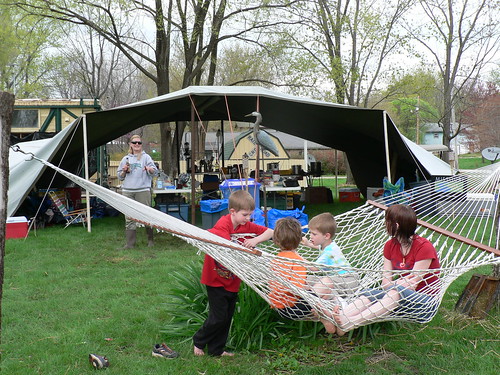
Special thanks to Brett and Tawnee Dufur, who hosted our crew camp at their beautiful Katy Trail Bed and Bikefest, and made a bunch of other things easier.

Thanks to the City of Rocheport for contributing to our lunch and disposal costs.

And thanks to the Missouri Department of Natural Resources for funding Missouri River clean-ups.

April 19, 2009

Thousands of baby caddisflies!

Water Quality Monitoring
February 8, 2009
Club Medfly, Missouri River, rivermile 170
text by Steve Schnarr, data collection by Melanie Cheney & Jen Courtney, photos by Melanie Cheney & Amy Jungclaus

Later this year, the Missouri Stream Team program will be turning 20. Since 1989, 3,860 citizen groups have formed across the state, each focused on monitoring, restoring and educating others about their adopted stream. The program is collaboration between Mo. Dept. of Conservation, Mo. Dept. of Natural Resources, Conservation Federation of Mo. and thousands of citizens.

Missouri River Relief is Stream Team #1875. Our adopted “stream” is the Missouri River within the state of Missouri (several other stream teams, luckily, have adopted various stretches within that reach). Typical River Relief grandiosity!

One of the greatest benefits of Stream Teams is the free water quality monitoring training and equipment that is offered. They get right down in the stream with you, showing you how to sample the critters that live in there, show you how to test for several simple chemical attributes and teach how to record data on the physical changes of your stream over time.

Much of what we learned in these classes is in a completely different context on the Missouri River. Turbidity levels considered alarming in some streams are considered clear on the Missouri. Families of critters usually associated with clear Ozark creeks have their members that are adapted to the turbid, muddy and sandy water of the Big Muddy.

At this point, we are just experimenting with monitoring the big river, learning what we can and adapting to its erratic levels.

One of the tools for sampling macro-invertebrates on big, fluctuating rivers is an “artificial substrate basket”. It’s a coated wire cage that you fill with rocks, tie a very long line to, and toss in the current. The critters that like to live in rocks move right in. You pull the thing out three weeks later with a fine mesh net and count everything that lives in there.

Well, that’s the way it’s supposed to work.

In the fall of 2007, we tossed a basket. The line wasn’t long enough. Soon after, the river came up, covered the rock we tied the line to and that was the last we saw of it for most of the year! When the river dropped enough to show our rope, we’d try to yank the basket out, but it was stuck under rocks moved by the floods.

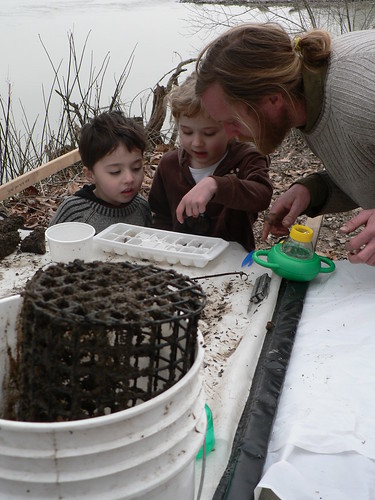
This January, though, the river was at the lowest it had been in a few years. I could wade out and dislodge the basket. So we invited Jen Courtney and her kids over, pulled the basket and checked it out.

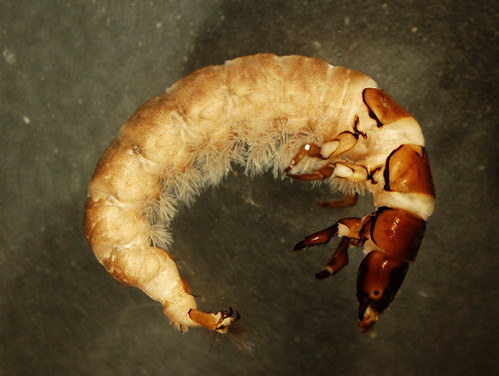
The basket and the rocks inside were completely encrusted with caddisfly larvae cases – this messy, gooey mix of mucus, organic particles, sand and mud that the little wormlike larvae use to protect themselves as they develop. And there were countless thousands of the larvae. Dragonfly and massive stonefly larvae came crawling out of the mess. A clawless crawdad scuttled in the net. Melanie carefully tallied up the critters.

Jack and Liv were fascinated – plopping insects into an ice cube tray, spraying them down with a bottle.

Then we headed back to the river, using a kick net to sample from overturned rocks in the swift current below Cooper’s Landing. We also used a D-net to sample from a larger area of rocks.
Two days later, the river jumped again, dropped back down, and now it seems will be high for the rest of spring. Who knows?

(also check out our flickr photo gallery of the day...you too could have this much fun! Start your own Stream Team)

Thanks to Barry Poulton (USGS River Studies), Mark Van Patten, Amy Jungclaus and Chris Riggert (MDC) and Priscilla Stotts (DNR) for sharing their knowledge of sampling and ID. Amy and Barry teamed up on the beginnings of a digital Missouri River macroinvertebrate reference guide. Barry is supplying specimens of characteristic Big Muddy macros, and Amy is taking close-up, ID quality photos of them. We are posting them on our flickr site as a set. Thanks for sharing your awesome work, Barry and Amy.

Here's a picture Amy took of the caddisfly larvae that we found in such abundance that day, Hydropsyche orris. I think its common name is a spotted sedge fly.

photo by Amy Jungclaus, MDC. Specimen provided by Barry Poulton, USGS River Studies.