Showing posts with label Club Medfly. Show all posts

February 19, 2013

Home Port Tradition

9th Annual Old Plank & River Road Clean-up
Cooper's Landing - Easley & Columbia, MO
Sunday, February 17, 2013
Text by Steve Schnarr, photos by Racin' Dave Stevens, Trash Tally by Ruthie Moccia

As winter nears its end and the ditches begin to fill with a year’s worth of throwaway trash, we get itchy to get out and clean up our gateway to the river here in Southern Boone County, MO.
We basically wait until the first “free” weekend with relatively good weather and no snow on the ground. Then, the Wednesday before, we put out the word….It’s the Old Plank and River Road Clean-up! 

We always get a great crowd, even at the last minute. Folks is ready!

Folks bring trucks and vans and trailers, kiddos, their personal favorite trash grabbing utensils, something warm to share and plenty of pent-up winter trash getting energy.


This was our 9th year in a row cleaning up this stretch of road. There tends to be less trash every year, but it’s still amazing how much there is. One thing that never changes is how good it feels to clean it up. 

We start at the intersection of Route K and Old Plank Rd (south of Columbia) and walk all the way to Cooper’s Landing. Actually we divide and conquer. It takes four or five groups of people to cover those five miles. We’ve only adopted 1.5 of those miles, but we always were over-achievers and figure we ought to cover the whole thing. Then we also send a group to cover the River Road and Katy Trail from Cooper’s Landing to Easley (another mile). If we have enough folks and vehicles, we also send a group toward “Party Corner” in the Wilton Bottoms, where they always find a bunch of junk to clean-up (plus at the Bonne Femme Bridge). We collect all the trash in two different kinds of bags – one type for recyclables (which get taken to the Columbia Municipal Recycling bins) and one type for general trash. 


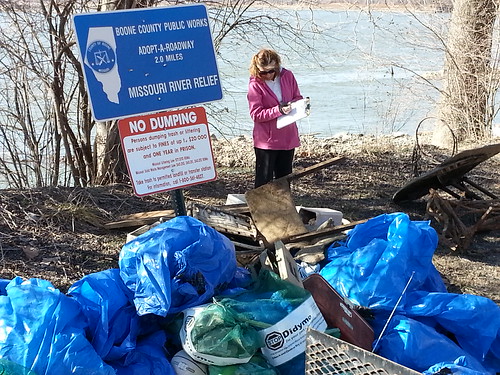
This year we got it all! And, as always, it was just a bizarre mix of stuff that had been tossed along our roads and river in a year…but mostly beer and liquor bottles and cans, cigarette butts and packs and, of course, little bits of plastic and food wrappers. There’s one road sign that is always surrounding by a crowd of bottles (target practice). There’s that mysterious conglomeration of beer cans that seem to be about a 12 ounce drive from the nearest convenience store. And there’s that spot on the river where some Mountain Dew drinker (and Camel smoker) likes to have lunch. Ugh!!!!
And then there’s the big, weird stuff. A toilet. A basketball goal, net and pole. The metal frame from a hide-a-bed. How can there be all this stuff….every year? 
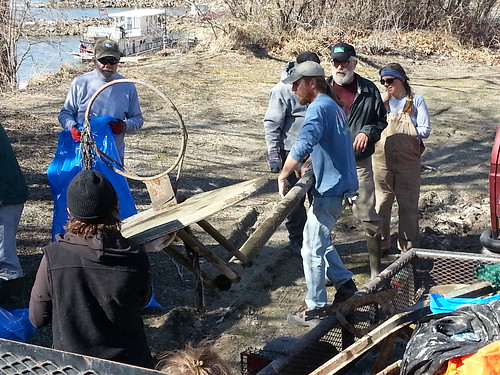

A big thanks to all of you that could come and help – that’s exactly what it takes. After loading up our trailers, we headed to our Club Medfly for some hot food, cold drinks and a little relaxation. A group photo by the trash, then we sort it all out into piles…a trailer full of recyclables and a giant pile of junk by our Adopt-A-Road sign (to be hauled off by the awesome Boone County Public Works crew). 

This year we were blessed by beautiful weather, sunshine, and a flock of gulls to watch flit along the river. 

The cleanup season has begun!
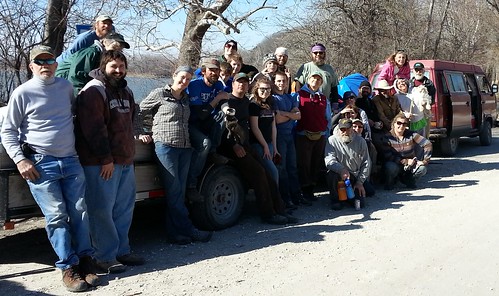
Just part of the cleanup crew...Riverbillies and River Relief!
Here’s the trash tally, as diligently recorded by the lovely Ruthie Moccia!

Trash Tally!
58 bags trash
68 bags recyclables
box fan
plant hanger
large red cooler
tackle box
matching set of deer antlers
microwave oven
tire
5 gallon red gas can
5 gallon metal bucket
5 gallon plastic bucket – 2
black plastic trike
toilet
standing basketball hoop
pregnancy test – 2 (both negative)
hide-a-bed
4 Mardigras bead necklaces
Jose Cuervo Margarita mix bottles – 12(!)
full soda cans – 2
Margarita mix
full beer cans – 7
full Mike’s Hard Lemonade
soccer ball
glass bong with frog décor
baby elephant – plastic
metal welcome sign
long handled brush – all bristles intact
folding lawn chair
upholstered chair (back only)
camp chair
picture frame (needs work)
12’ electrical cable
cow feeder top
rusted metal
stainless steel square with bolts
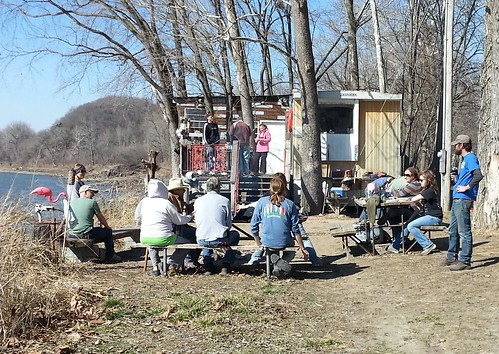
 
The crew relaxes after an awesome cleanup.


May 20, 2010

The Flood of 2010

May 14th, 2010
Club Medfly, River mile 170

As the Missouri River crested here in Mid-Missouri last week, several of us self-proclaimed "river rats" went down to our clubhouse to watch the swollen river roll by. She must have been going at least 10 miles an hour, carrying a large load of debris that not only included trees of all sizes, but an assortment of floating trash! The river level was 27.6 and rising.

I couldn't help but start recording a tally of what I was watching float downstream, ultimately destined for the Gulf of Mexico, which already has its fair share of problems with the most devastating oil spill on record, I couldn't help but feel both sad but reinvigorated to expose this local, regional, national, and worldwide problem.

Here's a tally of what we watched float by in one evening:

1 Large Freezer
15 Styrofoam Chunks
7 Basket Balls
4 - 5 gallon Buckets
5 Aerosol spray cans
1 Green Buoy
1 Inflated Inner Tube
1 Large Metal Tank
7 Tires
1 Milk Jug
4 Oil/Detergent Jugs
1 Purple Sharpie
1 Perfume Bottle Lid
1 Deoderant Stick
2 Misc. Balls
1 Prescription Bottle
2 Peanut Butter Jars
2 Coolers
1 Plastic Lime
2 Water Jerry Jugs
1 Metal 5 gallon Bucket
...and countless plastic bottles!

In ten minutes we counted 74 plastic bottles go by, only as far as the eye could see that is. Ten Minutes! 74!

Plastic water & soda bottles are by far the #1 piece of trash we find out there. If more people started carrying their own re-usable drink containers and started drinking from the tap, we would alleviate so much of the pollution that this plastic is causing by getting into our waterways, the ocean, and its wildlife. Plastic bottles are a product of crude oil. Think about the impact we could make if we stopped using them! We have the choice, and it all starts with YOU!


Melanie Cheney
Missouri River Relief

Catfish stuck in a Plastic Bottle, photo by Colby Wrasse of the US Fish & Wildlife Service

a photo of a storm drain that goes directly into the Missouri River after a rain event

April 19, 2009

Thousands of baby caddisflies!

Water Quality Monitoring
February 8, 2009
Club Medfly, Missouri River, rivermile 170
text by Steve Schnarr, data collection by Melanie Cheney & Jen Courtney, photos by Melanie Cheney & Amy Jungclaus

Later this year, the Missouri Stream Team program will be turning 20. Since 1989, 3,860 citizen groups have formed across the state, each focused on monitoring, restoring and educating others about their adopted stream. The program is collaboration between Mo. Dept. of Conservation, Mo. Dept. of Natural Resources, Conservation Federation of Mo. and thousands of citizens.

Missouri River Relief is Stream Team #1875. Our adopted “stream” is the Missouri River within the state of Missouri (several other stream teams, luckily, have adopted various stretches within that reach). Typical River Relief grandiosity!

One of the greatest benefits of Stream Teams is the free water quality monitoring training and equipment that is offered. They get right down in the stream with you, showing you how to sample the critters that live in there, show you how to test for several simple chemical attributes and teach how to record data on the physical changes of your stream over time.

Much of what we learned in these classes is in a completely different context on the Missouri River. Turbidity levels considered alarming in some streams are considered clear on the Missouri. Families of critters usually associated with clear Ozark creeks have their members that are adapted to the turbid, muddy and sandy water of the Big Muddy.

At this point, we are just experimenting with monitoring the big river, learning what we can and adapting to its erratic levels.

One of the tools for sampling macro-invertebrates on big, fluctuating rivers is an “artificial substrate basket”. It’s a coated wire cage that you fill with rocks, tie a very long line to, and toss in the current. The critters that like to live in rocks move right in. You pull the thing out three weeks later with a fine mesh net and count everything that lives in there.

Well, that’s the way it’s supposed to work.

In the fall of 2007, we tossed a basket. The line wasn’t long enough. Soon after, the river came up, covered the rock we tied the line to and that was the last we saw of it for most of the year! When the river dropped enough to show our rope, we’d try to yank the basket out, but it was stuck under rocks moved by the floods.

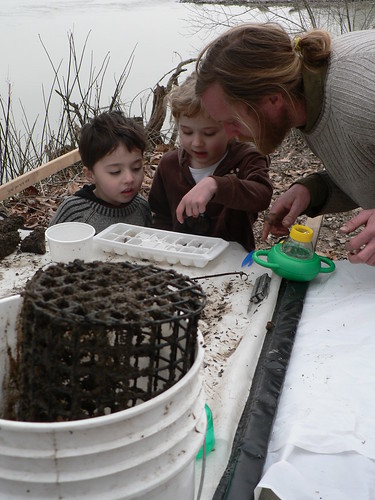
This January, though, the river was at the lowest it had been in a few years. I could wade out and dislodge the basket. So we invited Jen Courtney and her kids over, pulled the basket and checked it out.

The basket and the rocks inside were completely encrusted with caddisfly larvae cases – this messy, gooey mix of mucus, organic particles, sand and mud that the little wormlike larvae use to protect themselves as they develop. And there were countless thousands of the larvae. Dragonfly and massive stonefly larvae came crawling out of the mess. A clawless crawdad scuttled in the net. Melanie carefully tallied up the critters.

Jack and Liv were fascinated – plopping insects into an ice cube tray, spraying them down with a bottle.

Then we headed back to the river, using a kick net to sample from overturned rocks in the swift current below Cooper’s Landing. We also used a D-net to sample from a larger area of rocks.
Two days later, the river jumped again, dropped back down, and now it seems will be high for the rest of spring. Who knows?

(also check out our flickr photo gallery of the day...you too could have this much fun! Start your own Stream Team)

Thanks to Barry Poulton (USGS River Studies), Mark Van Patten, Amy Jungclaus and Chris Riggert (MDC) and Priscilla Stotts (DNR) for sharing their knowledge of sampling and ID. Amy and Barry teamed up on the beginnings of a digital Missouri River macroinvertebrate reference guide. Barry is supplying specimens of characteristic Big Muddy macros, and Amy is taking close-up, ID quality photos of them. We are posting them on our flickr site as a set. Thanks for sharing your awesome work, Barry and Amy.

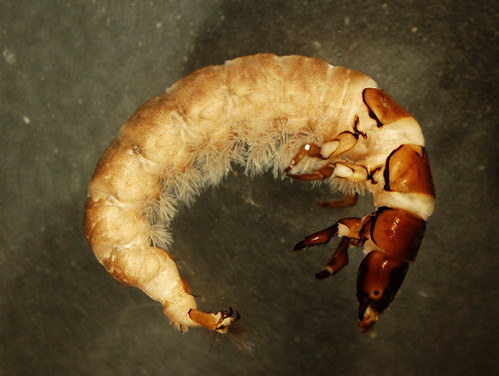
Here's a picture Amy took of the caddisfly larvae that we found in such abundance that day, Hydropsyche orris. I think its common name is a spotted sedge fly.

photo by Amy Jungclaus, MDC. Specimen provided by Barry Poulton, USGS River Studies.