Showing posts with label Katfish Katy's. Show all posts

May 24, 2018

Job Point Education Program - May 23, 2018

By: Claire Hassler, Missouri River Relief

Well, that’s a wrap on our “Stewardship on the Missouri River” education program! Missouri River Relief (MRR) spent the whole day at Katfish Katy’s in Huntsdale, Missouri working with AmeriCorps members from Youth Build and Job Point. The members were young adults, ages 16 to 24, from St. Louis, Kansas City, and Columbia, Missouri. They investigated the river at stations on land and then worked together in service of the Missouri River by picking up trash.
Morning Welcome and Introduction to the Missouri River
For this education program, we partnered with Job Point, which is an employment center that helps people with career planning and job placement assistance. Job Point was an excellent partner and this program wouldn’t have been possible without them. Thank you Job Point!

We started off the day by introducing the students to the Missouri River, Missouri River Relief, and Job Point. We were also grateful to have Senator Blunt’s Community Liaison Ailey Pope and the Boone County Presiding Commissioner Dan Atwill join the education program and give words of support.
Words of support and encouragement from Senator Blunt's Community Liaison
There were about 60 students at this program. We split them into two groups, 30 in each, because the day was divided into two segments: On the Water and On the Land.

On the Land
For one portion of the day, students rotated through three stations on land to learn more about the longest river in North America. The first On the Land station was called "We All Live Downstream." It was a stream table model of the Missouri River put on by Boone County Storm Water Education.


Hands-on and minds-on while learning how the river has changed over time 
Theresa Thomas and Lynne Hooper presented and instructed the students. They taught participants about how stormwater becomes contaminated and also how best management practices improve the quality and reduce the quantity of stormwater that enters the Missouri River.


Studying the kinds of bugs that live on the Missouri River
The second land station was called "Through the Eyes of a Scientist" and it was all about using microscopes to investigate macroinvertebrates that live in the Missouri River.  Amy Meier and Lily Kennedy with the Missouri Department of Conservation guided the students with the microscopes and showed them all kinds of bugs that live on the Missouri River. They taught participants about adaptations and assessing the quality of a stream site based on the macroinvertebrates that live there.

Station three on the land was a guided bird observation hike hosted by Paige Witek with the Missouri River Bird Observatory. Paige taught the students how to use binoculars and showed them bird skull replicas of species that live along the Missouri River. 
Giving pointers on how to identify the difference on species of hawks
On the hike, participants explored the natural history and adaptations of birds that live along the river and got to practice finding the moving birds in their binoculars. After a lunch break, the On the Land group and On the Water group switched places.


On the Water

After a safety talk and getting fitted for life jackets, participants headed out onto the river! MRR had three boats on the water. 
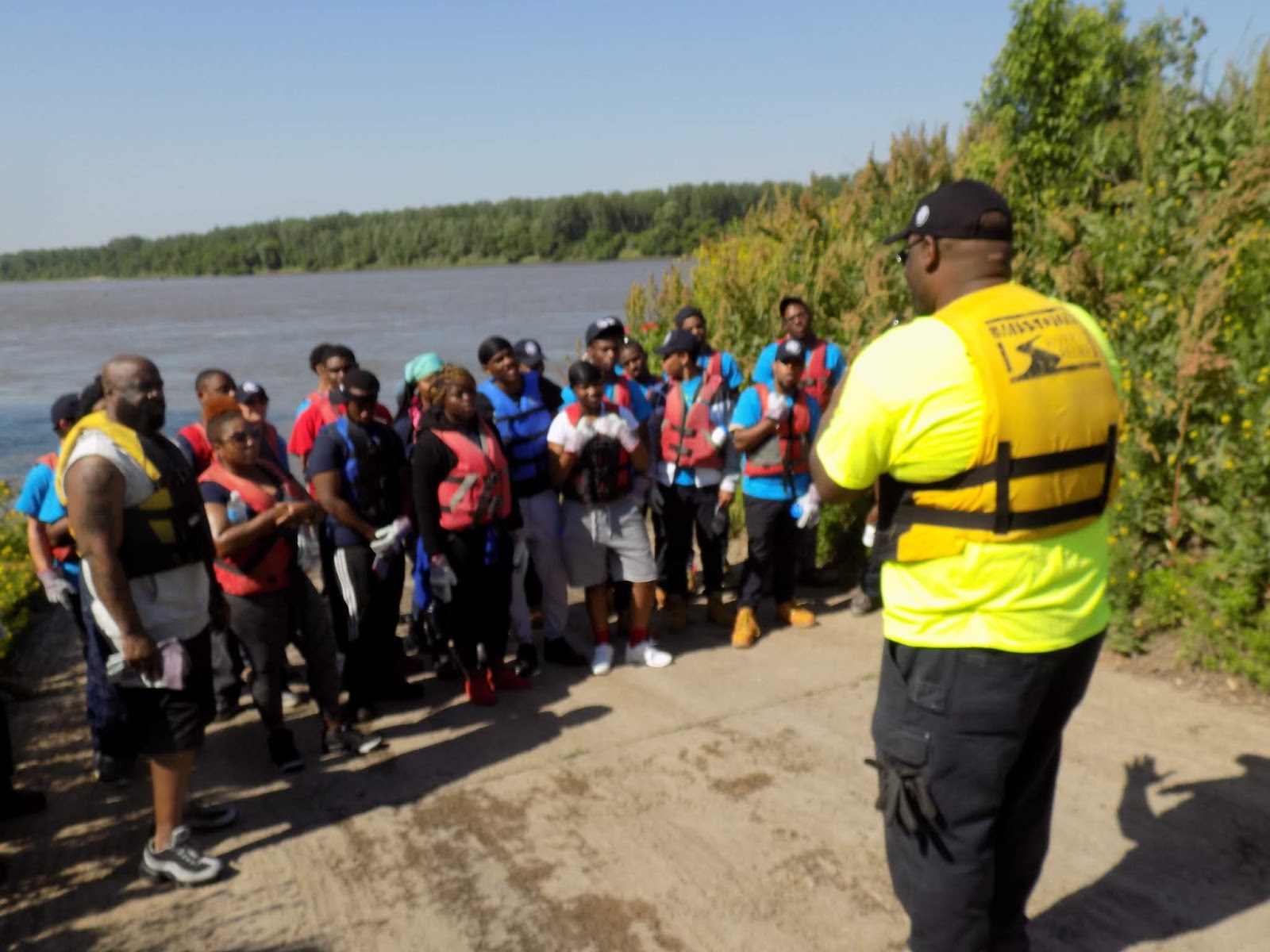
For a lot of AmeriCorps members, it was their first time on the Missouri River. 
Our experienced boat captains and deckhands gave the students a guided tour, pointing out an eagle’s nest as they passed it and sharing the history of the river. 


Looking in all the right places for river trash

Enjoying the river breeze with beautiful views of the bluffs 
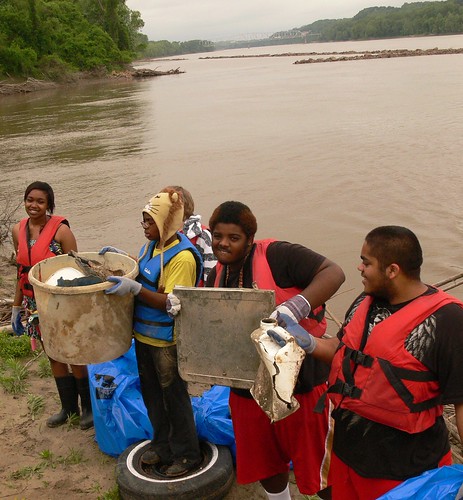
Some boats also stopped along the way to pick up trash. Here is the trash tally of what they found:
  • 21 bags of trash!
  • 55 gallon drum
  •   2 large Styrofoam chunks
  • 2 Large plastic tubs
  • Cattle feeding tub
  •  Large cooler (coffin cooler)
  • Plastic tool box
  • Large cooler
  • 3 tires on rim
  • Box tv
  • Fridge door
For many students, it was their first time out on the river. Because of this, a lot of growth happened.
At the end of the day as part of our group reflection, we did a whip around activity. The students stood in a giant circle and went around one by one, saying one word they used to describe the Missouri River before today’s program and one word to describe it after today’s program. 

Here are some things the students said: 
  • Before / After:
  • Big / beautiful
  • Trashy / cool
  • Watery / peaceful
  • Dirty / relaxing
  • Gross / refreshing
  • Dirty / fun
  • Scary / chill
  • Dirty / serene
  • Big / tranquil
The day was hot, but our students and presenters were champions and finished the day with smiles on their faces and chilled towels on their heads!

A lot of people helped make this program happen. A big thank you to our experienced boat drivers and deckhands: Steve Schnarr, Kevin Tosie, Jeff Boot Barrow, Patty Farrar, Steve Sadich, and Mike Crist. And our amazing presenters included Amy Meier, and Lily Kennedy with the Missouri Department of Conservation, Theresa Thomas and Lynne Hooper from Boone County Stormwater and Paige Witek from the Missouri RiverBird Observatory.

If you would like to learn more about MRR education programs, please contact Education Director Kristen Schulte at kristen@riverrelief.org, and check out our education program page!

May 17, 2018

Missouri River All-Stars, March - May 2018

By: Claire Hassler, Missouri River Relief

For the second year of Missouri River All-Stars, Missouri River Relief (MRR) partnered with the University of Missouri College of Education and engaged 125 fourth graders from Columbia Public Schools in after school programs. The goal of Missouri River All-Stars was to activate students’ innate sense of wonder and natural curiosity to explore the Missouri River, while increasing their knowledge and understanding of the river to deepen their connection and sense of responsibility to its care and stewardship.

Four schools participated in Missouri River All-Stars this year. Each school had four after school programs from March to May 2018 and one on-the-river field trip on April 29. During the after school programs, students learned about the Missouri River ecosystem and the impact that humans have on the river. They did this by going through stations, collaborating with their peers and problem solving. During the field trip, students also went through stations and got to experience the river firsthand. All-Stars also included a teacher curriculum development program that helped teachers collaborate with each other and integrate the river into their classrooms.

A group of excited students getting ready for their day on the river. Lifejackets – CHECK! 
After School Programs: 

In the first lesson, Discovering the Missouri River, students worked in groups to learn about claims, evidence and reasoning. They practiced making claims using evidence and reasoning through a picture walk. The students examined photos from a news article and then predicted what the article would be about. Next, students got in small groups to read and discuss the article “Our Missouri River.”

Students discuss “Our Missouri River” with Darcy Higgins, the All-Stars program instructor.
The second lesson, Structure and Behaviors of the Pallid Sturgeon, used four stations to engage students in the exploration of the adaptations and behaviors that help the pallid sturgeon, which is an endangered type of ray-fine fish, survive in the Missouri River.

In one station, students used a model of the pallid sturgeon’s life cycle to review important factors of transitioning from one life stage to the next. In another, the students drew predictions to explain how the pallid sturgeon is adapted to feeding on the dark, sandy bottom of the river. In a third station students created their own questions and defined problems based on observations of the historical range of the pallid sturgeon. In the last station, students watched a short video about the pallid sturgeon’s larvae drift and created Venn Diagrams of the survival and challenges the larva face.

Darcy Higgins poses questions for curious fourth graders during the after school program.
In Forces that Shape the Pallid Sturgeon Decline, the third lesson, students faced the question of how human alterations to the river have affected the pallid sturgeon. Students went through four stations and learned about how damns, sediment, channelization, and water-flow have brought change to the Missouri River.

Students discover the effects dams have on rivers by building their own models.
Field Trip: 

On April 29, the students had an on-the-river experience. The focus of the day was Recovery Plan for the Pallid Sturgeon. The students arrived at Katfish Katy’s at 10 a.m. and divided into four groups. The groups participated in two stations, had a break for lunch and then finished off the day with two more stations.

Students spent the day outside on the Missouri River All-Stars On-the-River day, experiencing the river firsthand and applying what they learned in the after school programs.
The first station, Experience the River, was a boat ride that incorporated spectacular views of the Missouri River for a one-of-a-kind learning experience. Students observed the differences between a chute, a nursery, and a channel on the Missouri River.

Students are ready to set sail for a boat ride!
The second station, Through the Eyes of a Scientist, was hosted by Dr. Ben Herman, who is with the University of Missouri College of Education. The station examined the relationship between students’ observations from the boat ride and what they learned during the after school program.

Classroom knowledge and real-life experiences intertwined during the Through the Eyes of a Scientist activity.
The third station, Through the Eyes of an Explorer, bridged the connection between art and science. Students learned about research conducted by Lewis and Clark and looked at their early paintings of the river. Students then used watercolors to document their view of the river.

Nothing beats lounging along the riverbank! Students use watercolors to paint the Missouri River, much like Lewis and Clark did.
The fourth station, Meet a Fisheries Biologist, introduced students to Carrie Elliot, Dave Combs, and Aaron DeLonay, who work with the U.S. Geological Survey and are helping to recover the pallid sturgeon. Students also got to practice the real-life research techniques the scientists are using.

Carrie Elliot and Dave Combs, biologists with the U.S. Geological Survey, teach students about their research techniques.
The students packed up and headed home at 2:30 p.m., ready to apply all their newfound knowledge in the final after school program of Missouri River All-Stars.

Teacher curriculum workshops:

Another facet of the All-Stars program was a behind-the-scenes teacher workshop. In the workshop, teachers used their Missouri River All-Stars experiences to develop and adapt their own lesson plans about the Missouri River. The teachers met once a week for four weeks at the College of Education office to collaborate and plan.

Teachers learn together with the MU College of Education
The NGSS-aligned environmental science and engineering based lessons were implemented in their classrooms and compiled into curriculum packs to be made available for other teachers.

Wrapping Up: 

The fourth after-school lesson, titled Scientific Arguments for Pallid Sturgeon Management, took place after the field trip. It addressed how scientists use claims, evidence and reasoning when debating solutions, specifically regarding pallid sturgeon recovery. In this lesson, the students split into two groups and developed their own solutions for pallid sturgeon recovery. Their plans included evidence and concepts addressed in previous lessons. Students had to consider the short and long term effects of their plans, who would be affected and what the next steps would be once their plan was put into action. The two groups then presented and debated their plans. The lesson concluded with students reflecting on how their views of the pallid sturgeon issue had changed since the beginning of the Missouri River All-Stars program.

Collaboration is key when it comes to problem solving and pallid sturgeon management.
We owe a huge thanks to our sponsor, the City of Columbia Stormwater Education and Outreach Program. All-Stars wouldn't have been possible without their support. The Missouri River All-Stars program was a smashing success this year, and we’re already planning for the 2018-2019 program. Stay up to date on information and contact Kristen Schulte, MRR’s education director, at Kristen@riverrelief.org and check out our All-Stars page.

May 14, 2012

On the River with Douglass High School

 photos and text by Steve Schnarr
click here to check out photos from past Douglass river trips. 

John Reid crop
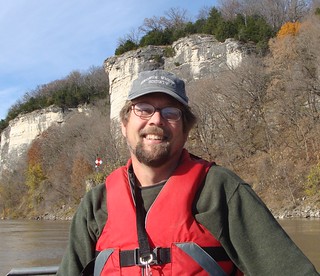
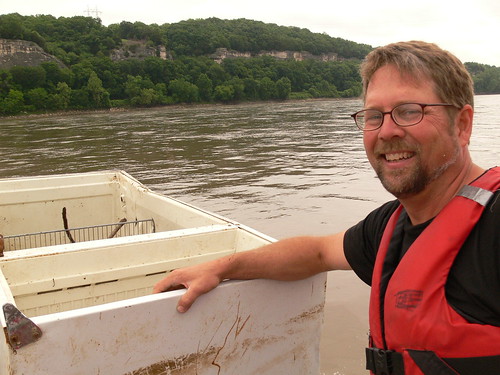
John Reid at the Manitou Bluffs
We’ve been taking Missouri River trips with John Reid’s students for four years. Mr. Reid, as his students of course call him, is not your average teacher. And the kids that come along with him on these river adventures are not your average student.
John works at Douglass High School in Columbia.

He started a “Service Club” at Douglass, where he creates opportunities for his students to work with local nonprofits, and to generally get out in the community and make it better through creek clean-ups, community gardening and ecosystem restoration projects. Four years ago, it was the Service Club that hopped on our boats after class for a quick river tour.

Among other subjects, John teaches Environmental Science. So a couple of years ago we started taking some of his Environmental Science students out on the river in the morning, and the Service Club in the afternoon, during school hours.

We get to work with the students that want to come, and put forth the extra effort to make the trip. John makes it easy for them, and everyone gets a pair of mud boots so they have no excuse not to get out of the boat and check things out.
Douglass High School Service Learning River Trips 5-3-12
The Morning Crew - Environmental Science Class
The first group of students that walked down the boat ramp were from the Environmental Science class. None of these kids had been with us on a river trip, and only one of them had been on the Missouri River before. As they walked down the ramp, they made comments like “We’re not getting in that boat” “I’m not going out on that river” “What if we fall in” and “I’ll just wait here on shore”.

After they got their safety talk (interspersed with comments like “What! I’m not going to be in a boat with no fish that big jumping in!”), though, they all eagerly hopped on the boat. It was obvious that, even with all the bluster, they completely trusted Mr. Reid. Half were lobbying for us to go fast with the other half shaking their heads.

The second group, from the Service Club, were a more adventurous lot from the start, used to Mr. Reid taking them outside of their comfort zones.
Douglass High School Service Learning River Trips 5-3-12
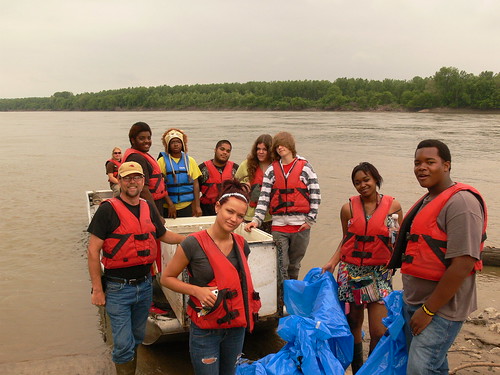
The Douglass High School Service Club cleans up the river. photo by Steve Schnarr

We show them the recreated Tadpole Island, where the Army Corps of Engineers dug a new chute across the river from Huntsdale. Before the river was channelized there was an island there called Tadpole Island, and now it exists again, ringed with sandbars.

A bit further upstream is an eagle nest. In May, when our spring trip usually happens, the babies are beginning to stand up in the nest and test their wings. One of the parents sits in a tree nearby watching.

On our first trip this year, none of the kids aboard had seen a bald eagle before. They loved it and couldn’t believe the size of the nest. “Who made that nest for them?” “How did they make a nest so big?”.

We discuss the near collapse and latest success of the bald eagle. About how DDT nearly wiped them out, just because it made their eggs too fragile. And now you can find a bald eagle nest about every 10 or 15 miles on the Missouri River.

If we have time, we motor on upstream past the Manitou Bluffs to I-70. Most of the kids had been on this bridge on their way to Kansas City. They mention how the river seems so much closer from the bridge. We feel tiny in our boat motoring past bridge piers swirling in the current.

We shut off the motor and drift under the massive trusses, checking out the cliff swallow nests tucked underneath, little clay jugs stacked up like apartments. Tucked into the bluff just next to the bridge is a cave mouth swarming with swallows. It’s easy to talk about how those bluffs were where the swallows naturally would build their nests, but the bridges work fine too.

Drifting back downstream, we come to Lewis and Clark Cave. Previously called Torbett Spring, this cave is now tucked behind the Katy Trail, with its spring waterfall emerging from a railroad culvert dated 1904 and tumbling down rip rap into the river. Meriwether Lewis noted the cave in his journal, with little drawings to depict the Native American petroglyphs painted on the bluff above the cave. 

We show the kids the remnants of the paintings that are left. “A “Nike Swoosh” with a dot above it,” is how Mr. Reid describes it, and the kids see it right away.
Daniel with Tire
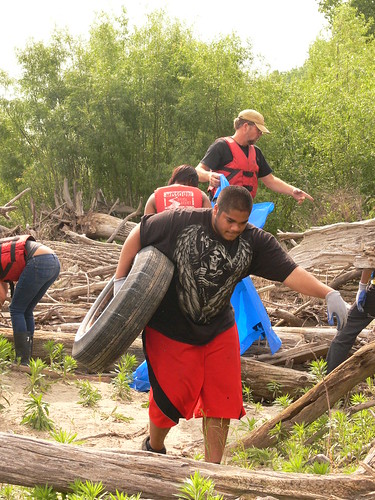
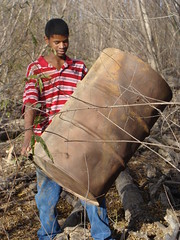
Daniel drags a tire from the rack pile.

If we have time, we explore the mouth of the cave (the interior of the cave is closed to the public to protect Indiana bat nurseries), but today we are running out of time. We need to move onto the clean-up.

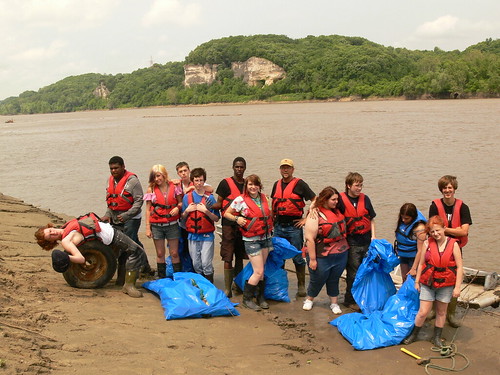
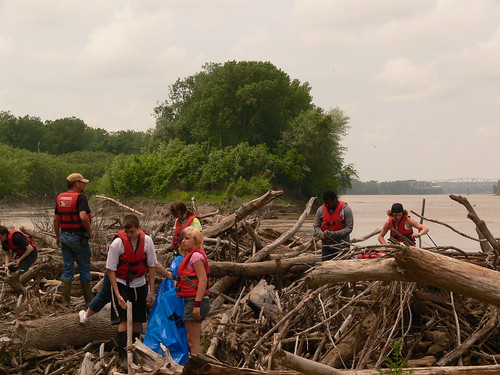
Morning and afternoon groups each get a different beach. This year, after last year’s high water, we clean up areas where driftwood has collected on the high banks. Balls, tires, plastic bottles, toys…all the usual suspects are there. The kids fill bags quickly, and help each other carry them across the wood piles. At first they’re bummed that they get some mud on their pants, but that disappears immediately.

They’re amazed at the trash they find out there.
Douglass High School Service Learning River Trips 5-3-12
Service Club scours the driftwood for trash.

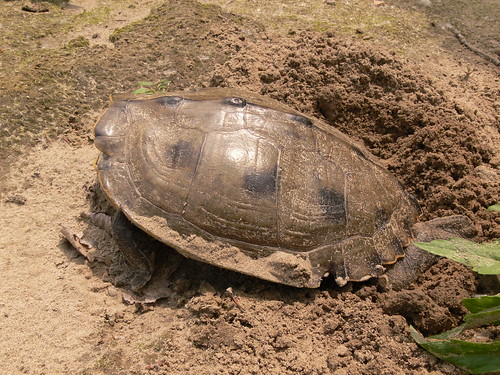
Map Turtle laying eggs on a sandbar near Rocheport. We saw a turtle laying eggs in the sand. A group of deer getting a drink by the water. We stomped in quicksand. Buzzards flew overhead in a cyclone.

Just another day on the river.

One group got two and a half hours…the other only two.

Mr Reid and his refrigerator
Mr. Reid and his fridge.
We see a refrigerator floating next to the bank. With just a few minutes left in the trip, we decide to see if we can get it in the boat. One student, Daniel, and I got in the bow of the boat, with John Reid trying to push the fridge from shore. It seemed impossibly heavy, but with Daniel using a shovel to pry underneath and me lifting a corner of the fridge, we got one edge up on the bow. Then it became much easier and we shifted the fridge into the boat. Everyone on board was proud.

Douglass High School Service Learning River Trips 5-3-12 And by the time we got back to shore, they were old river pros. “We saw eagles, Mr. Reid.” One student laughs at the mud on his friends shoes. “What are you gonna tell people about all that mud on you?” “I’ll tell ‘em I’ve been hanging on the Missouri River YO!”

This past winter we came up with a new award to give. To the teacher that really stepped up and helped us get kids on the river for a real experience. We decided to call it the “Floating Classroom Award” and we gave it to John Reid. In fact we were able to give it to him at our screening of the Wild & Scenic Film Festival in the Blue Note in Columbia.

With the support of his school’s administration, John makes amazing efforts to get these kids out of the classroom and into the natural world and their community. Teachers like this are absolutely priceless.

Who will get the “Floating Classroom” this year?

April 21, 2010

Garden Gate kids gettin' down & dirty on the River!!!

Educational River Trip and Clean-up
with Garden Gate School

Katfish Katies, Huntsdale MO
April 20th, 2010


Total Volunteers (students & parents): 22
MRR Captains & Crew: 4
Boats: 2
River Miles: 3
River Level: 12.7 ft
Landfill Tons: .29 tons
Tires: .045 tons
Total Tonnage: .3 Tons or 600 lbs of Trash!

Yesterday the Garden Gate School students & parents joined Missouri River Relief for an educational boat ride on the river and a river clean-up! A few weeks back, our Program Manager Steve Schnarr was able to go to their school and give a fun presentation on what our organization does, and what they could expect to see on their river trip in the weeks ahead.

It was a perfect & calm Spring day! The morning started out pretty cool but clear, by 10:30 a.m. the sun was blazing and the layers started peeling off as we life jacketed up the kids and prepared a short discussion & safety talk about the river.

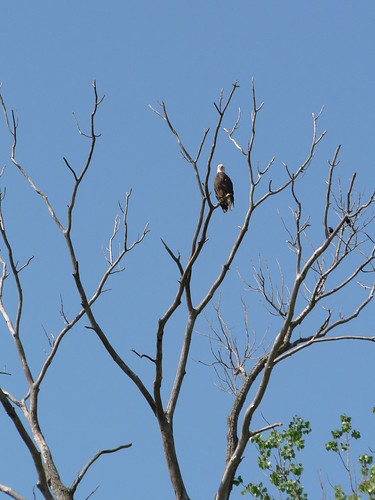
Next we loaded up the boats and set off upstream of the Katfish Katies boat ramp. Not long after motoring up stream, boat capatin Jeff Barrow pointed up to a large dead tree, it wasn't hard to see what he was trying to show us, sitting regal in near his nest was brother eagle, who bravely did not budge as we slowed for a closer look.


Moving on we came upon a boat of our National Fish & Wildlife Service friends doing Pallid Sturgeon sampling. We were able to watch them pull their lines in for a closer look at these ancient fish that still inhabit this great muddy river.


As our boat headed upriver to look at the petroglyphs left by the Indians many years ago & the spring running out beneath the great Manitou Bluffs, our second boat got waived closer by the fish & wildlife guys who apparently gave a wonderful presentation on their river studies and were able to show the kids a few of the large fish they caught that morning for an even closer up front view.

Well it didn't take long before everyone started getting hungry. So we motored back downstream to the little island just across from Katfish Katies we like to call Airplane Island. The shoes came flying off & a warm sunny picnic lunch was devoured on this gorgeous little sand bar. Afterwards, the kids got to wander around the little island, dipping there toes in the water, building sand castles, finding bugs & trash, & doing their typical kids in nature things. It was fun to watch.

After a bit though, the kids all wanted to get wet & go swimming, so we rounded them up & headed just across the river to a young willow thicket that we knew always gets trapped with tons of trash! We spent maybe an hour gettin' down & dirty with the Garden Gate kids & made a pretty good haul!


Trash Tally!!!!

10 large blue Stream Team bags filled with mostly plastic bottles - soda bottles, anti-freeze jugs, motor oil bottles etc.
6 small mesh Stream Team bags
3 Tires
1 blue 55 gallon Plastic Barrel
1 30-gallon brown Plastic Tub
1 very large Tent that had to be dug out of the mud
an assortment of Balls – basketballs, baseballs, tennis balls, golf balls footballs, etc.
at least 3 Six-Pack Rings (that I personally picked up, there may have been more!!)
1 5-gallon plastic Paint Bucket
1 5-gallon metal Varnish Can
1 Light Bulb
1 long florescent Light Tube
1 plastic Milk Crate
1 plastic Plant Tray
1 dead Turtle

photos & text by Melanie Cheney

A huge thanks to a really fun, good natured, and inquisitive group of students & parents yesterday, we had a blast showing them our beloved river, and introducing them to what is likely to be many new river adventures ahead!

To see more photos about this fun river outing, check out our Flickr Photos here: http://www.flickr.com/photos/8478409@N03/sets/72157623780900515/

November 3, 2009

Educational River Trips

High School Service Club takes to the River!
Huntsdale, MO
November 2, 2009

text & photos by Melanie Cheney
For 2 gloomy, cold & wet weeks, Douglas High School teacher John Reid watched the forecast, trying to plan for his service club's annual river trip with Missouri River Relief. Finally, the weather cleared & on a beautiful sunny November Monday, we got the chance to show these Columbia kids how beautiful the Big Muddy can be while doing the river an act of service in the process.

Although the peak of fall colors were long gone, our group of 8 students, 1 teacher, and 4 River Relief crew were still able to admire the crisp burnt oranges & browns along the Manitou Bluffs, shout a greeting to a lone bike rider on the Katy Trail & poke our heads into the Lewis & Clark cave by the spring. The leaves had fallen from the towering Cottonwoods, and I was able to point out two Eagle nests within a one mile stretch.


We turned off the motor & drifted downstream along the bluffs in the cool, gorgeous sunshine. An enormous amount of rain the previous week had raised the river to a strong 17 feet. Other than the swift current, the water was calm & clear of debris. We took advantage of the river level and took the boat into a massive drift pile I had been eyeing all year, normally blocked by a boxed-in wing dike. Along with the massive pile of wood debris, was a thick concentration of plastic bottles as far as the eye could see.

At the beginning of the trip, we had explained to the students what we did as a clean-up organization and how we used the very boat they were sitting in to haul tons of trash off of the river with the help of volunteers like themselves. Arriving at this site though, needed no further explanation, we had to clean the river up! It was just a mess! So we handed out trash bags & gloves & set the students to work. Within twenty minutes, we had collected enough trash to almost fill the boat. Leaving two neat piles of trash on the bank, we returned the Service Club to the ramp at Katfish Katy's. We enthusiastically thanked the students for helping us make a difference if not a big dent in the amount of trash on the river, and headed back to finish the final haul.

Here's a tally of what we ended up with:

16 Bags of Trash (mostly plastic bottles)
1 Truck Tire
1 Mower Tire
1 small Refrigerator
1 55-gallon Metal Drum
5 Light Bulbs
2 small Coolers
3 3-gallon Plastic Buckets
6 Flip-flops & Croc Sandals
15 Balls
1 small Coleman Propane Tank

An estimated .3 tons (600 pounds!!!) of trash

A special thanks goes out to their teacher, John Reid, for caring enough to take these kids out on the river year after year. It is such a pleasure to watch the transformation in these kids at the end of the day. Not just by getting them out on the river, but by introducing them to the beautiful natural surroundings that are less than half an hour away, something many people in "the city" often forget is right in their own back yards.
-->