By: Claire Hassler,
Missouri River Relief
Last week, Missouri River Relief (MRR) was in Kansas City for a two-day educator workshop. Three teachers from the Kansas City area gathered with us to learn more about the Missouri River and how they can integrate the river into their classrooms. The teachers’ students ranged from elementary, to middle school, to high school. Regardless of the different ages of their students, all the teachers were eager to learn and bring exciting new content to their classrooms.
 |
| Ready for a day on the river! |
Day one:
Where is the best place to start a Missouri River educator workshop? On the river! We did just that. Our group met by the boat ramp of Kansas City Riverfront Park. After all the teachers arrived we introduced them to our crew: Kristen Schulte (MRR education director), Jeff “Boot” Barrow (MRR executive director), and myself, Claire (MRR education assistant intern). The teachers also went around the circle to talk about their goals for the workshop and their history
with the Missouri River. One of the teachers and I had never been on the river before, so all of us were excited to get out on the boat.
After a safety talk and life jacket fitting, we were off! While Jeff motored us downstream, everyone got acquainted with the river. We shared observations that started with “I notice, I wonder, It reminds me of…” At one point we noticed a memorial site for a fisherman, which included a giant bobber and some flowers. We wondered if that was his favorite spot on the river and how often he went there to fish.
 |
| We enjoyed incredible views of the Kansas City skyline from our boat. It was the perfect mixture of city and nature. |
As we headed back upstream, Kristen taught about the history of the Missouri River. We visited the rock ledge that “gave birth to Kansas City” because it was the first place where everyone would dock their boats. The teachers lamented that the rock is only accessible from the river as they would’ve loved to bring their students out to see it.
 |
| Kristen shows the teachers the rock ledge that helped found Kansas City. |
We learned about the ecology of the Missouri River and how it has changed over time, both naturally and artificially. Kristen taught us all about wing dikes, which have been a huge driving force of change along the Missouri River. Wing dikes are rock ledges that jut out from the riverbank and were built by the U.S. Army Corps of Engineers to control the width of the river and keep the current away from the bank. The teachers had fun guessing where the wing dikes were located under water, looking for rock piles on the bank or debris floating in the river that seemed to be caught on something under the surface.
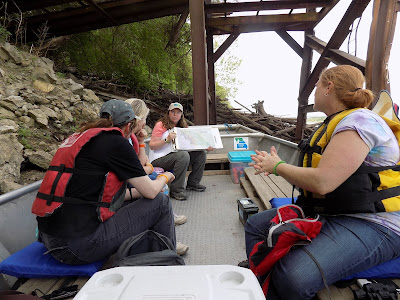 |
| The group pulled over on a shady bank to learn more about the ecology of the Missouri River. |
We ate lunch at Kaw Point, where the Missouri River and Kansas River intersect. As we were pulling up to the bank, Asian carp leaped out of the water to greet us. Luckily, none landed in the boat! We munched on chicken salad sandwiches and M&M cookies, applied fresh layers of sunscreen and talked about the joys and hardships of teaching, all while gazing at the beautiful Kansas City skyline.
 |
| One of our teachers poses by a statue of Lewis and Clark during our lunch break at Kaw Point. |
After lunch and while our food digested we did a “walk and talk.” We hiked around Kaw Point while Kristen asked us questions, which we then discussed in pairs. We talked about living things on the banks of the Missouri River and at the bottom of the river, and how the various environments impact the way species live and adapt. We even saw some snow geese!
 |
| Kristen shows the group a map of varying depths of the Missouri River during a “walk and talk.” |
For the second half of the day, we focused on the pallid sturgeon. Eager to escape the heat, Jeff drove the boat to a shady bank where we could get out and relax in the sand. We passed around stations that had activities relating to the pallid sturgeon’s life cycle and hunting behaviors. Kristen also told us about planning and management strategies regarding the pallid sturgeon, as it is an endangered species.
 |
| Teachers examine different kinds of sturgeon, held up in jars by Kristen. |
We took one last river cruise back to the boat launch and then the teachers departed, ready to rest up for another day of learning on Friday.
Day two:
On Friday morning Kristen and I met the teachers at the MU Extension Office in the River Market District of Kansas City. We would spend the day in the classroom learning how to apply the knowledge from the day before.
To start off, Kristen shared a structured outline of a Missouri River lesson plan with the teachers to help guide them with their own lesson planning. We also went over how people learn and modeled that with an activity and lesson about food webs in the Missouri River.
 |
| Teachers listen and take notes as Kristen presents the Missouri River lesson plan. |
We let things simmer and took a tour of the
Arabia Steamboat Museum. We learned about how people navigated the Missouri River in the 1800s with steamboats, and how dangerous a steamboat journey really was. Here’s a wacky fun fact: When the Arabia sunk, it was buried so quickly with sediment that everything was pristinely preserved, even the food on board. So when the crew excavated the site 132 years later, they found perfectly good buttermilk, pickles, and Champaign. They even ate the pickles and drank the Champaign themselves!
 |
| An enthusiastic tour guide introduces us to the Arabia Steamboat Museum and all the unburied treasures inside it. |
As tasty as 132-year-old pickles sounded, Neopolitan pizza was more our speed. We headed to
Il Lazzarone Pizzeria for lunch. The pizzas were served individually, so we thought we’d never be able to finish all of our food. As it turned out, that wasn’t an issue. Each of us finished every last bite.
 |
| We all gasp about the size of our pizzas and wonder how we’ll ever finish them all. |
For the final stretch of the educator workshop, the teachers drafted and modified lesson plans to incorporate what they’d learned about the Missouri River the day before and make learning more experiential for their students. All three of the teachers decided to go above and beyond and tackle modifying an entire unit instead of just one lesson. After they had time to work on their plans individually, we convened in a group and each teacher shared what they had come up with.
We ended the workshop with a group reflection. Each teacher had come with different experience and prior knowledge of the river, so each got something different out of the last two days.
River and eager to bring it into the classroom to inspire their students too. The teachers said their experience was enriching and they felt more comfortable and capable teaching about the Missouri River in their classrooms.
If you would like to learn more about MRR educator workshops, please contact Education Director Kristen Schulte at
kristen@riverrelief.org, and check out our
education program page for registration information, financial aid opportunities, and upcoming events. See you on the river!