Showing posts with label Florissant MO. Show all posts

March 20, 2013

An Island Adventure

Pelican Island Adventure
with John Burrough's students
Pelican Island Natural Area, Florissant, MO, Missouri River

March 18-20, 2013

text by Steve Schnarr, photos by Margaret Bahe, Francis Baum, Steve Schnarr & Roxi Pop

Pelican Island is a 2000-acre island on the Missouri River 16 miles upriver from the Confluence. It’s mostly covered with a mature bottomland forest, with patches of old fields and younger trees and brush. At low water, it’s ringed by sandbars, sometimes even connected to St. Louis County by a chute full of sand and gravel.
Sunrise on the head of Pelican Island, overlooking the Car of Commerce chute. photo by Francis Baum

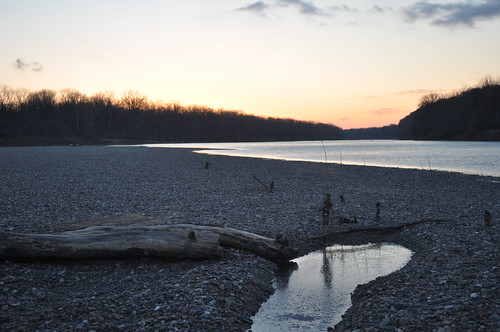
At the head of the island is a 10 acre pile of gravel and sand, parts of which are exposed at even fairly high water. It’s a rock gallery of the whole watershed. Stones from all over the Missouri River basin pause here on their slow tumble to the Gulf of Mexico, alternatively exposed and covered by wind and water. Petrified wood, bone, driftwood. I know of no other place quite like it on the Missouri.

This was going to be our home for several days, shared with a group of John Burroughs School teachers and students.  Our timing was both lucky and difficult. A couple weeks before, much of the gravel bar was underwater, flooded by a pulse of snowmelt from the Great Plains. Levels were going to be relatively stable while we were there, raising about a foot and a half. The bar is large enough to comfortably contain our rambling camp, but is totally exposed to the wind, which would rarely leave us over the few days we’d be living there.

Getting there
Our drive from Columbia to St. Louis was fraught with difficulty. The alternator on one of our vans froze up, breaking the serpentine belt. Luckily it happened at a truck stop. So we switched all of our equipment around, moved all the gear from the defective van and just left, heading to the river. Meanwhile, Racin’ Dave and John Brady drove to Foristell with a replacement alternator and belt and did the fix so we could retrieve the van later.
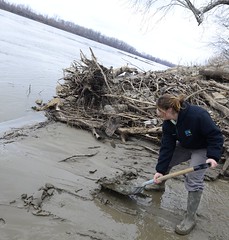
Jodi scoops gumbo from the ramp. photo by Roxi Pop

Our put-in spot was a private boat ramp near the historic site of the Halls Ferry, also known as the Musick Ferry. This was a spot where travelers could cross the Missouri River then cross a narrow neck of St. Charles County to have access to  the Upper Mississippi and Illinois Rivers. The ramp is owned by the Warren family, who has owned property there for over 150 years. When we arrived, Doug and Dave
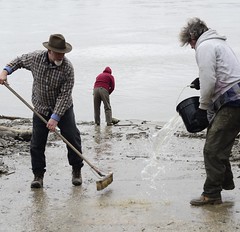
photo by Roxi Pop
Warren were already working on clearing the ramp which was covered in logs and mud deposited by the falling river. We joined in, and within one back-breaking hour the ramp was clear of mud and obstructions.  Brothers Doug and Dave were incredible hosts to us.

When our crew arrived on the island, it was blowing too hard for us to set up our Flying Nun kitchen tent, so we erected a v-shaped windbreak out of tarps and t-posts. Wishing we had more of both. That little tarp wall saved us, providing a small wind-free space for storage, cooking and hunkering down.
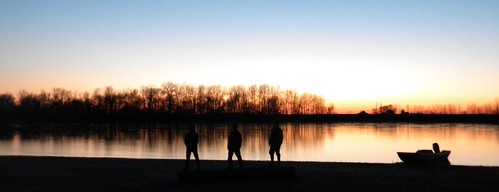
Our first sunset on the island. Tim led us in a round of Xigong stretches. photo by Steve Schnarr
The fire was placed not far behind it keeping us out of the direct force of the wind but creating a swirling, smoky eddy. But as we finally relaxed after a difficult day of travel, breakdowns, near crashes, gear schlepping and mud clearing we stared above us at the beautiful spread of stars and watched the moon light up the river and rocks. Tim Nigh led us in a twilight session of Xigong and stretches on the river’s edge. This was going to be good.

Our guests arrive
Getting ready for our new island guests, our first task of the morning was to send a crew back to the ramp to retrieve and deliver the porta-potty. The portable toilet was somewhat of a disputed subject. It was certainly convenient, solved several important problems and even provided a temporary windbreak. But these things are awkward, heavy and in some ways a cop-out for some of our wilderness hardened crew.

And difficult to move by boat.

But we had promised the parents it would be there, so it was really a non-issue. So haul it we did…(its final resting place was about 10 feet from shore right by our landing….that’ll have to do!)
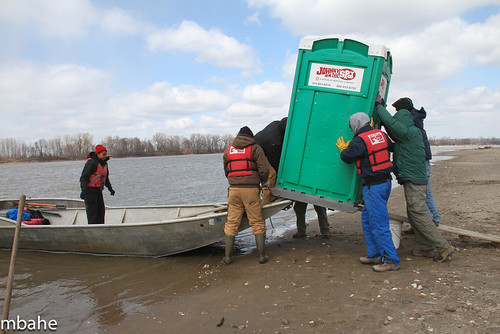
Loading the Porty-Potty. photo by Margaret Bahe.
Then it was back to the ramp to meet the members of the John Burroughs Missouri River Adventure crew. 30 teachers, sophomores, juniors and seniors were giving up part of their spring break for a Missouri River camping trip and clean-up. For years, there had been a service trip available to JBS students during spring break. Past years have included Joplin and New Orleans, helping communities a year after they had suffered a disaster. This year, it was service to the river that runs through the heart of Missouri.
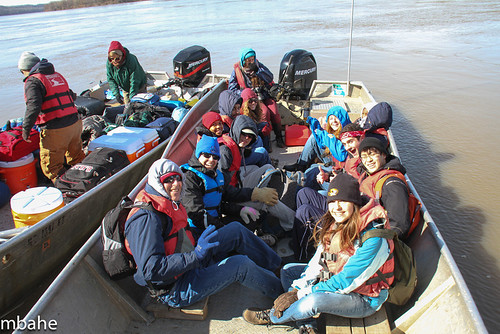
One boat for gear, one for people. photo by Margaret Bahe. 

We loaded up one boat with gear and the other with passengers and started the shuttle. Landing on the island was tricky. We couldn’t get right up to shore because the slope of the island was too gradual. We laid out our boat benches as ramps to walk to shore through the shallows. It worked great!
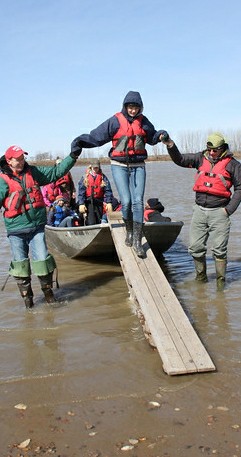

photo by Margaret Bahe

As the kids started figuring out where they would set up their tents, the wind really picked up. Setting up the tents was both a comedy of errors and a triumph of ingenuity. It took pieces of driftwood, heavy iron poles and a plethora of creative knots and lashings to keep these tents held to the sandbar.

Spring Cleaning on the river
As we all ate lunch, the wind gradually settled down, although never all the way. The students had already divided into groups, each led by one of their talented teachers. One group headed into the woods on the island to scour the forest for trashy flotsam. The others hit the river, targeting what we thought were the most likely trashed spots in the area.

We spent the afternoon getting to know the river and getting to know each other. Everyone was amazed at the kinds of things they found washed up ashore, from toys and furniture to TVs and refrigerators.
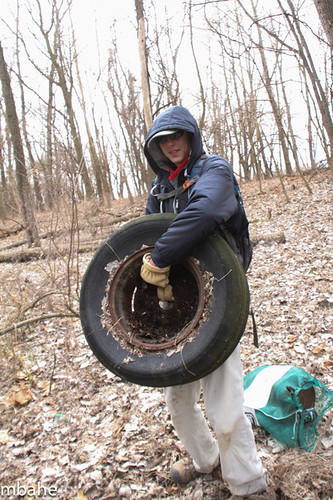
And, of course, every plastic item you can imagine. We put in a really solid cleanup set before heading back to camp.

One of the sites we hit was the boat ramp we used to launch our boats and load the students. The ramp is owned by the Warren family, who has lived at the site for more than 150 years. This bend in the river was the Hall’s Ferry, once known as the Musick Ferry. When we arrived at the ramp on Monday, they were already working on clearing the ramp of mud and driftwood logs after the previous week’s rise and drop in the river.
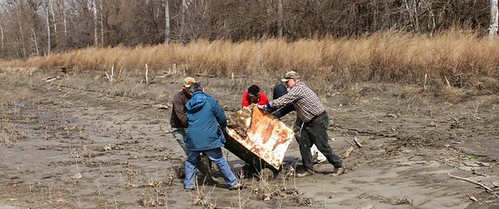
Crews use a dolly to move a refrigerator through the mud. photo by Margaret Bahe.
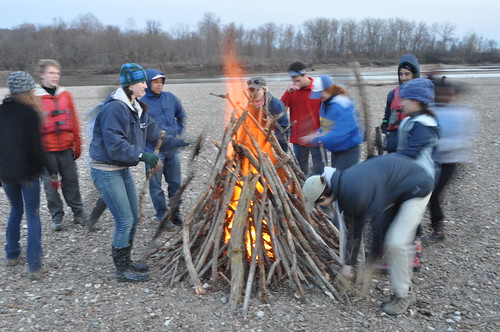
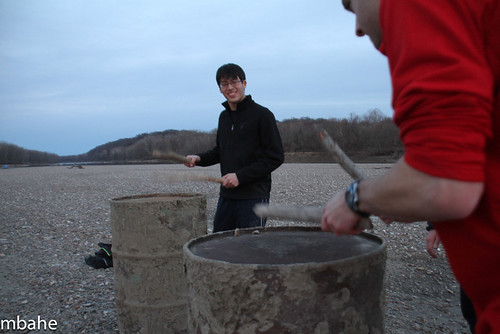
Teacher Margaret Bahe and her student group set up dinner. Several piles of meat, veggies and sauces were laid out with big sheets of aluminum foil. All of the other students were sent out on the island to find baseball diameter sticks of driftwood to pile up. They made a HUGE pile. Then a smaller fire was started and the kids moved that pile of wood again, creating a massive tipi. Soon it was a tower of flame, as the sun set in the west. Several of the 55 gallon drums that had been retrieved from the center of the island were set up as drums with several students keeping the beat and spiraling sparks were swept by the wind across the sandbar.

Building the bonfire. Photo by Francis Baum.
Oil drum percussion on the island. photo by Margaret Bahe

That pile burned down and we raked the coals into a 20 foot bed. Everyone created “steamboats”: aluminum foil wrapped around a filling of veggies, meat and sauce. Some were swans, some boats, some giant metal rings. When the coals were ready, everyone plopped down their packets at once for a half-hour simmer.
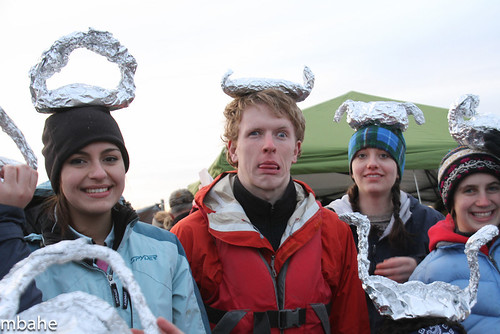
These kids were fun. photo by Margaret Bahe.


S’mores (of course) and handwarming commenced. The night turned out relatively pleasant, with diminishing winds and lots of comradeship. But there were a lot of chilly sleepers on Pelican Island that night.

We were so impressed with the crew of kids that came to the river. They worked hard and made the camp work. They were witty, talented, curious and often hilarious. We felt lucky to share the island with this group and wished we had a few more days to get to know them better.

Camp as the sun was setting. photo by Francis Baum.
And the crew of teachers was fantastic. Jeff Dee was the point person (his wife Susan was actually the organizer of the trip even though she couldn’t make it), purchasing and organizing the food for everyone. Margaret Bahe was a catalyst, bringing her years of experience organizing student outdoor experiences. She was able to immediately round up forces of kids to accomplish whatever was needed. Mylan Johnson has the ability to see the next task at hand and figure out the most efficient way to accomplish it. Jill Donovan brought a sense of adventure and joy to the experience.

Our River Relief crew was awesome as well. Jodi Pfefferkorn was off the barge, so she joined in. She does the work of four ordinary people, with a sense of humor and a relentless drive. Tim Nigh became the camp host, tidying up our kitchen and organizing the kids into work groups to gather firewood and do clean-ups. Tony Sudekum was amazing, bringing his years of experience doing wilderness expeditions. Francis Baum sacrificed his back for this one…and captured lots of great photos. Melanie Cheney kept rolling with the punches and did an excellent job piloting one of our boats. Roxi Pop documented everything and became that extra hand when we needed it. And Steve Schnarr pretended to know what the plan was…

Here's a really great video put together by Roxi about the entire adventure:


Morning. Break camp and clean up the river. 
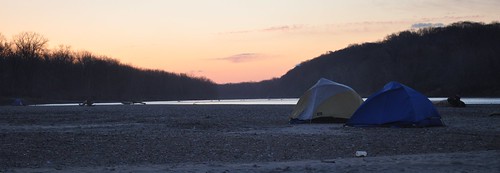

The wind returned with force in the morning, and stayed with us all day. The kids stoked up the fire and huddled around  First thing after breakfast (hot oatmeal and hot cocoa) we broke camp in a swirling sandstorm. Then it was back on the river for more clean-up.
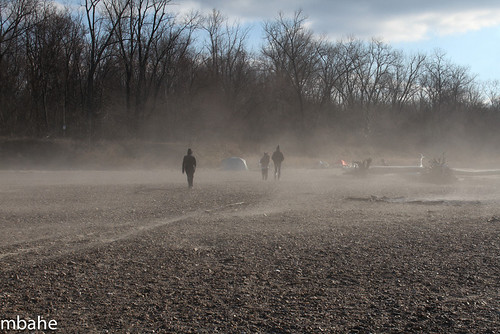
The wind kicked up a sandstorm as we broke down our tents. photo by Margaret Bahe.
 Each group split up and tackled different sites along the river and one group returned to the forest of Pelican Island. Now we were a many armed team. Some groups continued to collect trash from the riverbanks and others helped haul trash to the boat ramp and then up to the dumpster placed there.

By the time we came back for lunch, we’d put in a good jag of work. But we still had the whole camp to get off the island. Complete and total team work got everything moved down to the beach. An assembly line moved each piece of gear off the sandbar and into the boats. And yes, the porta potty too. Coach Johnson rigged up a clever ramp to slide this sanitary unit up and into the boats…much easier than what we had come up with.

After several back and forth trips, the job was done. All the river trash was disposed of. All the camp gear was stowed. And everyone looked forward to a hot shower at home.

Everyone involved rolled with the punches. Everyone got a unique, deep and direct experience with the river. And everyone left it a much cleaner place. Success!

Alternative Spring Break with John Burroughs Results

Teachers & Students:  29
MRR Crew:  6
Boats:  2
River Miles Cleaned:  2  (Rivermiles 15.5 -17.5)
River Level: 14.5 on St. Charles gage
Tires: 14 (.3 tons)
Landfill Tonnage:  .9 tons
Scrap Metal:  rolled in with landfill

Total Tonnage:  1.2 Total Tons!

Trash Tally!!!!

69 Bags of Trash
14 Tires (1 large Truck Tire)
2 Tire Rims
4 Chunks of Syrofoam
2 Coolers
1 5-gal. Plastic Bucket
4 55-gal. Metal Drums
1 55-gal. Plastic Barrel
1 Lawnmower
1 TV
2 Regrigerators
1 Compressor
2 Freezers
2 Old Glass Bottles
Dozens of Balls:  Basketball, Football, Softballs
1 Tarp
1 Intake Manifold
9 pieces of Scrap Metal
4 Tomato Cages
1 Shop Vac
1 Bottle of Laundry Detergent
1 piece of Carpet
1 Plastic Lid to a Dumpster
2 Copper Pipes

May 7, 2007

Bird, Bugs and Botany – May 7, 2007

A naturalist’s foray on Pelican Island Natural Area
by Steve Schnarr

After a successful Learning Festival and clean-up, we were excited to try something new during River Camp. Tim Nigh envisioned a day where naturalists from different disciplines would tromp together through the woods and sandbars of Pelican Island Natural Area to learn from each other about the web of life there.

Members of a Webster Groves botanical organization, who have been meeting every Monday for decades for botanizing field trips, came early to walk the beautiful Sioux Passage trail alongside the “Car of Commerce” Chute which forms Pelican Island. (The chute was apparently named for a riverboat that sunk there back in the day.)

Shortly after noon, other area naturalists, including members of the Confluence Chapter of Missouri Master Naturalists, members of Audubon Missouri and other assorted nature freaks converged on the Sioux Passage Boat Ramp, curious about what this odd day would bring.

We suited everyone up in lifejackets and split folks into three groups, trying to keep an even balance of birders, botanists and entomologizers. Tim Nigh and John Brady took a boatload up to the head of Pelican Island, where Anthony was preparing our camp for an premature tear-down due to the impending flood. They scoured the sandbars and adjacent bottomland forest, checking out the unique sandbar species as well as the proliferation of exotics within the forest.

The two other groups headed to opposite sides of the island, one group on the Missouri River side and the other on the chute side. From there they explored old channel sloughs, towering cottonwood forests and abandoned fields.

From a botanical perspective, things looked pretty grim. Although the forest was dominated by a native canopy of elm, cottonwood, several species of maple, hackberry and mulberry, the forest floor is dominated by exotics. Japanese hops, bush honeysuckle, lambs-quarters and more provide the bulk. And, of course, more nettles than you’d ever want to meet in a dark room.

The highlight was the migrating warbler population. The birders in the mix were dumbfounded by the amount of warbler activity that late in the day (we were in the woods from 1:30 to 4:00 p.m.). Magnolia warblers, blackburnian warblers, bay breasted warblers and more were darting among the viny canopy, appearing to feed even that late in the day.

As the boats headed back to the ramp, my boat went downstream to pick up a few “artificial substrate” baskets (essentially metal cages filled with rocks) that we had places two weeks earlier for a water quality monitoring workshop scheduled later in the week (cancelled due to the flood). To our amazement, they were still there, and Mike Leahy (Natural Areas Coordinator for MDC) hauled them in. We spread the rocks out in a plastic swimming pool at the boat ramp and checked out the life within. Everyone was amazed that the Missouri River, long believed to be devoid of life, a veritable toxic waste dump of the Midwest, could harbor such a mix of quality macro-invertebrates. From caddis-fly larvae to dragonfly nymphs and mayfly larvae, there was a lot going on in one of those samples.

Following the event, we had an hour for all of us nature freaks to discuss what we saw on the island and give our own educated guesses on what patterns we could see. For our first naturalist foray, we packed up feeling like a success! And we met some wonderful St. Louis area nature freaks just like us.

May 5, 2007

Stream Team Clean-up - May 5, 2007

Sioux Passage Park, Florissant, MO

by Vicki Richmond and Steve Schnarr
photos by Vicki Richmond, Jen Courtney and Melanie Cheney
Saturday morning dawned drippy. Grass still wet from Friday's deluge made footwear decisions easy- a mud boot day for sure! After a crew meeting held over steaming fresh country eggs, the River Relief crew launched boats, set up the sign-in table and got supplies ready for action.

This clean up was a diversion from the usual River Relief uber-event. Designed for the Stream Team participants in the area, this clean up was as much about connecting people doing the tireless job of river keeping as it was about the trash. Smaller numbers of participants gave us opportunities to exchange savvy, stories and contact information, all while picking up trash.

Volunteers from Stream Teams #516, 1573, 211, and #1 (yes, Mark Van Patten, who started the first Stream Team, came too!) as well as the Parkway North Stream Team and the St. Louis Americorps ERT loaded in to boats and headed just a couple miles down stream to a large dump located on the MegaScout project last fall. A cast iron tub proved no match for these stalwarts. Motorcycles and bedsprings were loaded like cordwood into our plate boat, Saskia, and returned to the Sioux Passage ramp.


MDC fisheries biologist Danny Brown took out a crew of Stream Teamers from Parkway North High School for a “fishing” expedition, picking trash right out of the river from drift racks pushed aside by the rising water.


After lunch, crews boated to a spot upstream of the previous dump and soon found an abandoned boat up in the weeds. This is where the expertise of our crew of diehard Stream Teamers got really impressive. They popped the top half of the boat off, pulling the massive piece of fiberglass down the slope with a rope tied to the Saskia. Soon after, the hull came sliding down the bank as well. With a few careful maneuvers and tie-downs, they whole mass went boating back down to the ramp to be unloaded by the Sioux Passage front-end loader and deposited in the dumpster.

As tired crews returned to camp, MRR Quartermaster John Brady and a revolving crew of cooks served up a feast of delicious chicken roasted for hours on an open fire as stories of the day were recounted. An evening program hosted by author and MRR coordinator Jeff Barrow accompanied the riverside dinner. Stream Team members had the opportunity to present their activities to the group.


This networking opportunity is invaluable for planning, learning and cooperation across the watershed. Of course experiencing a river sunset, a sandbar campfire and a well-prepared dinner helps to build the next generation of river stewards as well.

Here's a partial tally of trash for the day:

23 large Stream Team bags of trash
8 tires
1 Several steel posts
1 TV stand
27 steel rods
1 air conditioner
1 motorcycle (Illinois license 554 421, Dec. 1984)
1 piece chrome trim
1 leaky washtub
one large water softener unit and tank

1/2 toilet tank
1 16 foot bass boat
1 metal roof truss
1 box spring
1 Nimrod popup camper (w/little red light)
partial furnace
5 fan blades
1 lawnmower
2 propane tanks
4 BIG metal rods
1 stainless steel restaurant deep fryer
15 feet of hardware cloth
1 mower deck
12 sheets of metal
3 t-posts
about 3/4 of a stove
1 torque converter for an automatic transmission
1 cast iron tub
2 bundles of wire
10 circus tent pegs
1 volleyball net and pole
1 fragmented toilet
2 wheels
several pieces of carpet
1 sewer pipe
1 portapotty wall
1 office chair pedestal
1 flame spreader
1 piece of chrome trim
1 TV antenna
1 tire rim
1 CB radio
1 55 gallon metal drum
1 muck bucket
1 water tank
1 spool
cluster of spaghetti wire
1 toilet lid
many, many balls of every kind!!!


this sunset was captured during the after rain river mist on Friday, May 4, by Vicki Richmond

May 4, 2007

Sioux Passage Learning Festival - May 4, 2007

Water Education in the Rain
by Vicki Richmond and Steve Schnarr

With a resounding splash, 274 middle school students from the Hazelwood School District headed down to the Big Muddy for a day of serious water education at Sioux Passage Park.

Protected from the drenching rain with trash bag ponchos, the students toured 16 learning stations with an emphasis on water. These education booths were staffed by stalwart agency, corporate, and nonprofit presenters who endured a 1 ½ inch rain.

A strange sea of umbrellas stood inside a 24 foot trash hauling boat and beside the double 225 HP engines of the Missouri Water Patrol boat. Educators from Missouri American Water demonstrated how turbid water from the "Big Muddy" gets tranformed into drinking water. Americorps volunteers showed off a collection of macroinvertebrates while Mark Van Patten showed how he ties masterful fishing flies. AEP River Operations brought a display on the economical uses of barges on our big rivers. Not deterred by a rainy day, Troy Gordon of the Friends of the big Muddy (with his two daughters patiently huddled under his pop-up tent) amazed kids and chaperones with an enormous snapping turtle, found in the same habitat that rings the park.

A planned picnic lunch became lunch on the bus and/or huddled under tents as the rain slowly tapered off. We couldn't help but be impressed by the toughness of the kids, teachers and presenters that stayed during the whole soggy event.

Special Thanks to event Coordinator Lynne Hooper, for pulling this together on a day with a myriad of conflicts, and to Hazelwood Science Coordinator Susan Raney for rolling up her sleeves and joining right in the soggy fun.