Showing posts with label Friends of Big Muddy. Show all posts

September 28, 2009

A Week on the River

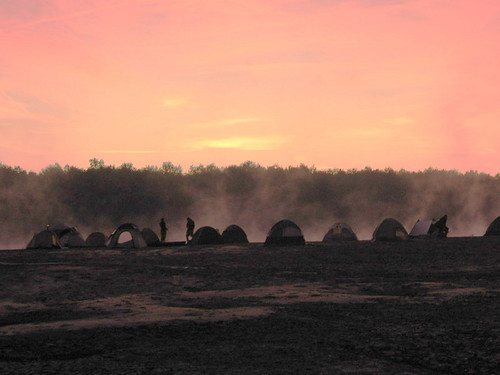
River Camp 2009
California Island (RM 177)
Manitou Bluffs Conservation Opportunity Area

September 11 - 20, 2009
text by Steve Schnarr, photo by Francis Baum
Back in 2007, we tried to put together a week of activities and networking in the St. Louis area we called River Camp. A Watershed Festival, Stream Team Clean-up and naturalist foray onto Pelican Island went off without a hitch.

As we began setting up our big tent on a beautiful sandbar on the head of Pelican Island, in came the NWS weather report: a “wall of water” was heading down the Missouri River toward St. Charles.

We had to pull up stakes and head back home to help with sandbagging and flood preparations.

Ever since, we’ve been dreaming of a River Camp Reprise. This year was our chance.

Within the idea of River Camp was another, even older idea. The desire to get our sponsors, partners and friends on a sandbar for a unique banquet under the stars. From that idea came the bigger concept that, if we’re putting up infrastructure on an island, we might as well pile on a series of other events, bringing together diverse groups to accomplish diverse things along a certain stretch of river.

For River Camp 2009, we decided on our home stretch of river. With access from Katfish Katy’s, Cooper’s Landing and Eagle Bluffs, we had ultimate flexibility. With our local history and partnerships, it became easier to work with other groups. And with our strong mid-Missouri crew, we knew we could pull it off.

The fact that California Island is located along one of the most remote and beautiful stretches of river within Manitou Bluffs Conservation Opportunity Area was an added bonus.

So here was our schedule for the week. Check our blog as we update it with photos and stories from the week:

Saturday & Sunday, Sept. 12 - 13
Missouri River Clean-up with Sustain Mizzou and other University of Missouri organizations. We invited folks from this awesome organization to camp with us on the island, then hit the river for a clean-up from Katfish Katy's to Cooper's Landing.
• EcoArtFest - This is a fundraiser for MoRivCC, a non-profit that archives recorded video and audio of local musical treasures. Missouri River Relief hosted a booth and trash to art exhibit. We also offered a sunset cruise raffle and educational boat trips on Providence Bend of the river.

Monday, Sept. 14
"Birds, Bugs and Botany - A Naturalists' Foray on the Missouri River" We hosted a mix of professional, amateur and aspiring naturalists for a trip on the river, making species lists of the plants and wildlife we found at Eagle Bluffs CA, Plowboy Bend CA and Overton South Unit of the Big Muddy National Fish and Wildlife Refuge.

Tuesday, Sept. 15
• We hosted the Friends of Big Muddy and Big Muddy National Fish and Wildlife Refuge staff for a pot-luck and campfire discussion on the island.

Wednesday, Sept. 16
• Missouri River Relief Crew and Board Meeting on California Island.

Thursday, Sept. 17
River Managers' Forum and Field Trip - We invited local river managers and biologists to join us on an afternoon river field trip.
River Camp Sandbar Banquet- Our sponsors, partners and friends were invited for a magical evening on California Island, with dinner, music, a presentation and bonfire on California Island.

Saturday, Sept. 19
Jefferson City Missouri River Clean-up - Click here for results of this awesome event. Over 270 volunteers helped remove 5.6 tons of trash from the river.


June 1, 2009

Troy Gordon Memorial Project

May 23rd, 2009

Arrow Rock, MO


A little over a year ago, we lost a great friend & partner, Troy Gordon. As many of his friends & family came together to share a story, a hug or a laugh, we collected almost $2,000 to fund a memorial project to honor this special fallen hero. After all, it was not Troy’s spirit to stand around & contemplate, but to act! And we did just that on a beautiful Saturday morning in the little historic town of Arrow Rock on Memorial Day weekend.


Troy passionately worked on behalf of many organizations. Among them, the Big Muddy National Fish & Wildlife Refuge, Missouri Master Naturalist, Missouri River Relief, Missouri Stream Team, and he founded & worked with Friends of Big Muddy just to name a few. He focused much of that work in the bottomlands of the Missouri River in addition to his educational efforts, introducing kids and adults to the birds, snakes, turtles and other wildlife that live in Missouri.


To honor Troy’s life work, we chose a trail that he had worked so hard to help implement with Fish & Wildlife partner, Tim Haller at the Jameson Island Unit of the Big Muddy Fish & Wildlife Refuge in Arrow Rock. In addition to Jameson Island, there are currently 7 other units of protected river habitat in the Big Muddy Refuge. Comprised of 11,000 acres strung up and down the lower Missouri River, this important resource continues to grow and evolve as the Fish & Wildlife Service acquire more of the Big Muddy’s floodplain from willing sellers, restoring and preserving parts of this once wild ecosystem. For more info. on the Big Muddy refuge, visit their website.


On a warm & steamy May morning, Friends of Big Muddy came together once again for a work project on the refuge, like so many that Troy had organized in the past. With project funds donated in his name, we built a platform to place a memorial plaque & bench along the Arrow Rock Landing trail to the river, and replaced many of the invasive & nuisance plant species taking over the bottoms with over a hundred native wildflower’s & shrubs! So instead of Garlic Mustard, Multi-flora Rose & Winter Creeper, there are now Wild Sweet Williams, Celandine Poppy’s, Spiderwort’s, Golden Ragwort’s, Wild Ginger, Silky Dogwood’s, Paw-Paw’s, False Indigo’s & Buttonbush’s. It was a beautiful sight.


We followed our workday with a gourmet BBQ lunch, good company, and a quiet feeling of triumph as Friends of Big Muddy was resurrected after more than a year. Mostly, I feel thankful for all of the organizations & people that Troy has brought together. He certainly left a lasting legacy, and some pretty big foot steps to fill, but I feel confident that in due time we will close the huge gap that he left, with each new step.


Special thanks goes out to Tim Haller, Randy & Tom Bell of the Big Muddy Fish & Wildlife Refuge for all of their hard work & coordination in making this event go off without a hitch, Troy’s widow Janine, for being such a trooper and continuing to help us fill his footsteps, Tim Nigh & Dinise Mustain for preparing our gourmet lunch, the local farmer’s for providing us their with quality, feel-good-food, Missouri River Relief’s new hard-core crew members for volunteering for the work day even though they didn’t know Troy, and the many friends, partners, & family that donated either their time, support or money to help create such a nice tribute & memorial to Troy.


Thank you.

November 8, 2007

Digging in for diversity

Overton Bottoms Tree Planting
November 3, 2007
Big Muddy National Fish & Wildlife Refuge


text by Steve Schnarr, photos by Melanie Cheney
(Note: The hardwood trees we planted were donated by Living Lands and Waters (www.livinglandsandwaters.org) and Forrest Keeling Nursery. The native bottomland shrubs were purchased at more than 50 percent discount from Missouri Wildflower Nursery. Refuge staff selected the site and species and mowed the area. Friends of Big Muddy and Missouri River Relief coordinated the event. 37 volunteers from Kansas City, Orrick, Columbia, Rocheport, Lupus & Boonville planted the trees)

We drove down the steep hill from the cabin, crossed the railroad tracks, and drove across the bottoms. A light frost, soon to melt, blanketed the grass and the table we had set up the day before.

Just as the gloves, t-shirts and coffee were laid out, the first volunteers started to arrive. The immediate task at hand was wrapping the trunks. 150 trees were wrapped by a growing army. Another group grabbed shovels and headed down into the lower terrace with refuge Asst. Manager Barbara Moran to plant shrubs: elderberry, rough-leaved dogwood, false indigo & buttonbush.


A trailer was loaded with wrapped trees and pulled through the planting, with a couple folks unloading five trees at a time into small clumps. The trees got laid out in a grid (for easy mowing…not natural aesthetics…) and pretty people split into pairs and were planting away.

Looking across the planting field, scattered with young oaks and backs bent putting them in the ground, the background was a dark line running five feet high throughout the woods edging the bottom. The line marks the height of this spring's flood, serving as a reminder that any messing around we do in these bottoms is subject to the whims of the river herself.

The morning was perfect down in the valley. The sugar maples along the bluffs were at peak color, brightening as the morning went on. It was quick work, and soon we realized…we’re done.


37 folks took part, including some very small children who did everything from gathering empty pots and flags to patting down the soil around the young trees.

The effort was symbolic. Another new tract of land had just been added to the Big Muddy Refuge, and here was a bunch of river loving folks showing up early on a Saturday morning to help shape it. As the last pots and flags were gathered up, most of the folks went with refuge Asst. Manager Barbara Moran and Troy Gordon of Friends of Big Muddy for a walk down to the river, passing through the thick, new cottonwood forest, patches of older forest and past several scour hole ponds created in the 93 flood and continuing to harbor waterfowl throughout the winter season.

We met back at the beautiful blufftop cabin for lunch and a presentation on the refuge. Everyone still had energy and time to enjoy the beautiful fall day.

Click here to check out the great Columbia Tribune article on the day!

Restoring what?

Overton Bottoms Tree Planting
November 3, 2007
Big Muddy National Fish and Wildlife Refuge


text by Steve Schnarr, photo by Melanie Cheney
These tree plantings are often called restorations, but that is probably the wrong word for what’s happening. If you want trees to grow in most places of these bottoms, you just stop mowing. You’ll get trees – you don’t have to plant them. These hardwood plantings are actually a real artificial attempt to bring something back to the area that nature rarely, but importantly, provided before historic times.

The situation on the ground now is that a majority of land on the refuge is undergoing a rapid natural succession cycle. There are patches of older forest, but most of the visible bottomland is cottonwood, willow, silver maple and sycamore grown up since the 95 flood. It’s a race for sunlight, and these fast growing trees are tall and slender. Only the oldest trees have branches that stretch out into the forest.

Those trees that get crowded out die and fall to the ground. The forest floor is criss-crossed with logs, branches and fallen vines – slow-release fertilizer for the future. In this scramble for the sky, slower growing trees like oaks don’t have a chance. When the river ran free across the bottoms, accumulating patches of disturbance, varied soils and topography, trees like oaks and hickories found places where they could get a foothold. In this new situation, where suddenly thousands of acres of land are being taken out of cultivation and allowed to grow up in trees, where are these footholds?

So humans make decisions, based on a lot of ecologically irrelevant reasons (like property boundaries, previous land uses and available funds), to artificially bring a little diversity to the equation. History and old survey lines show that there were rare pockets of oaks throughout the Missouri River bottomlands, attracting their own mix of wildlife. Most of these were logged for firewood, to fuel steamboats and as railroad ties. Occasional pockets of pecans were found in the Missouri River bottoms. Some speculate that these were all planted by Native Americans who saw how useful and flood tolerant they were.

So, once again, nature and human intention are mixing. It’s yet another time of rapid change in the Missouri River bottoms, and once again, people and the many forces of nature are in a push-pull effort. We just hope that this time, our efforts will help and not harm.