July 17, 2019

Missouri River Academy, July 7-11, 2019


By: Katie Hathaway

It’s hard to believe another Missouri River Academy has come to an end. Every year is unique and incredibly special, but this year was really one for the books. The lessons learned and friendships made will not be soon forgotten.

Campers and a few staff members pose outside of Peers Store during their bike ride on the Katy Trail!
During this year’s Missouri River Academy, high school students from across the state gathered for 5 days in New Haven, Missouri, to learn about the Missouri River, all while not actually being able to go on the Missouri River, due to this year’s flooding and high water level. Despite not being able to get out on the river, this year’s academy was just as magical to be a part of.

To give you a better idea of how the week flowed, here is a day-by-day breakdown!

Sunday, July 7th – Welcome to Missouri River Academy

Twenty-one eager campers arrived at Camp Trinity and were welcomed to the 2019 Missouri River Academy! The first day of camp was focused on getting to know one another and gearing up for the next four days of learning about the Missouri River!

Campers prepare for the first round of Missouri River Olympics!
An Academy staple, Missouri River Olympics, kicked off and four fierce Olympic Teams were formed! Children of Lupa, Below Sea Level, Better than Kampbell, and GELEC competed in a series of games and activities throughout the week for a chance to win a special prize.

The day finished with a night scavenger hunt hike, where students got to know each other better and learn about the stars.

The campers embark on their night hike!

Monday, July 8th – Connecting to the Missouri River

With the question “How do I explore my connection to the Missouri River?” in mind, the second day of Academy included getting to know the history behind the Big Muddy, and learning about how it functions.

The day started at Pinckney’s Bed & Breakfast on a beautiful overlook above the Missouri River, where we learned about the history of the Missouri River, and some of the extinct wildlife that once roamed the watershed by examining fossilized teeth!

Campers Mackenzie and Emma practice using hand lenses to refine their observational skills.
We then headed to the riverfront in downtown New Haven and learned about sedimentation of the Missouri River. While along the waterfront, we broke out the blue trash bags and did a river clean up, Missouri River Relief style! Students picked up trash and also looked for their own trash treasure, which they could use for their creative art project later in the week.

Charlie and Gabe disposing of some trash during the river clean up.
In the afternoon, students participated in an 8-mile bike ride along the Katy Trail, stopping along the way at Peers Store to learn about the history of the area. After a day being out in the sun, the pool at Camp Trinity was a favorite hangout spot for most students during community time.

Later in the day we explored a nearby stream and met wildlife along the way. Many toads, grasshoppers, and other insects were caught!

Campers check out some captured wildlife during the stream exploration activity!
During Missouri River Olympics the competition was fierce, but Below Sea Level took the lead after winning a couple rounds of a tag game called Keeper of the Castle!

The night capped off with stargazing, during an astronomy and night sky lesson, where students learned more about what’s beyond Earth. They even saw the rings of Saturn!

Tuesday, July 9th – Behind the Scenes of the Missouri River

During the third day of academy, we explored the ecology of the Missouri River. Students focused on the question, “What components make up the Missouri River ecosystem?”

We started the day off at Shaw Nature Reserve for some serious birding with Missouri River Bird Observatory! We saw and heard 17 different bird species, including an Indigo Bunting, a Summer Tanager, and a Blue Herron!

Campers look for birds using binoculars and bird identification books. 
The fun continued as we did some nature journaling with artist and outdoor educator, Angie Jungbluth. To prepare us for capturing the natural world on paper, Angie challenged us all to rethink how we draw with various sketching techniques, such as blind sketching and gesture drawings. We even learned how to draw a bird song! She also led a watercolor lesson, where students painted the forest at Shaw Nature Reserve.

Angie reviewing what birds campers had just listened to during the "draw a bird song" activity.
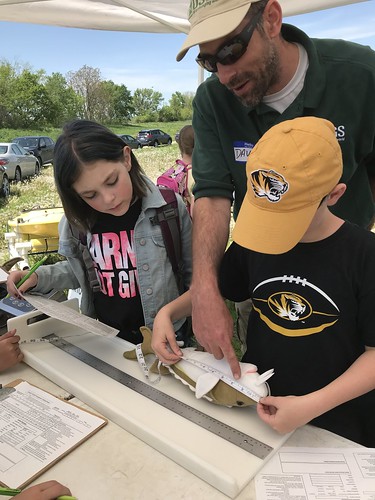
River Academy wouldn’t be complete without a little time on the water! We headed to the Meramec River where we participated in some fisheries activities with Sarah Pepers and her staff from Missouri Department of Conservation. We caught fish using nets and through electrofishing! The Missouri Department of Conservation folks were kind enough to educate us on what fish species we caught as well. We caught a wide variety of fish, two of which were the Stoneroller and Brook Silverside!

Campers trying out electrofishing on the Meramec River!
After spending some time out on the river, we came back to Camp Trinity where Darby Niswonger and a couple other wonderful folks from MDC had a fish fillet demonstration waiting for us! Many students got to test their hand at preparing catfish to be fried, while others had the opportunity to enjoy fishing!

Campers fishing around the lake at Camp Trinity.
Missouri River Olympics were tough! All teams played their hearts out in a game of Capture the Flag, but after solving a tough riddle, BTK took the lead.

Day three of Missouri River Academy ended on the best note possible- with an ice cream social at New Haven Ice Cream Shoppe!

Wednesday, July 10th – Forces that Shape the Missouri River

From learning about wastewater treatment along the river, to hearing stories from those who have paddled the river, to discovering how life has developed in a historic river town, we dove into a number of activities to get the kids thinking about the question, “What is the relationship between humans and the Missouri River?”

We kicked off the day touring the wastewater plant in New Haven and got the chance to learn about the importance of treating water, as well as the challenges that go with it. We learned about the hardships various flushed products have on the wastewater treatment process!

Lance presenting a glass-blown sea turtle to the campers!
We then visited Astral Glass Studio in downtown New Haven, where Lance Stroheke and Gary Rice demonstrated glass blowing for us! They created a bluebird and a sea turtle right before our eyes! Afterward, they talked to us about their experience paddling 1,300 miles on the Missouri River! The kids also really enjoyed hanging with their shop dogs.

While downtown, we stopped by Avant Garden, and Charissa Coyle talked to us about the importance of supporting local agriculture, as well as how this year’s flooding and heavy rain has impacted growing produce in the Missouri River Valley. Using ingredients from Avant Gardens, we made fresh salsa together and celebrated with tacos for lunch!

Jay and Bridget cutting up peppers fresh salsa.
After lunch, we headed to Deutschheim State Historic Site in Hermann and traveled back in time to explore Hermann’s German roots while touring historic family homes.

After a day of activities, we headed back to Camp Trinity, where students were introduced to the Creative Art Project. Campers partnered up, chose an issue relating to the Missouri River, and began thinking about how to develop their projects!

The Olympic Games were intense, but after winning the “Face the Cookie” challenge, and solving the most riddles, Below Sea Level took first place again!

The Olympic teams attempting to solve riddles.
We finished out the evening making s’mores around a campfire together. The best way to end a day at camp!

Thursday, July 11th – Connecting Others to the Missouri River

The last day of Missouri River Academy was spent reflecting on the past week and thinking about how to take what was learned beyond New Haven, Missouri. Students focused on the question “How do we deepen a sense of responsibility to the care of the Missouri River?”

We kicked off the day with the final round of Missouri River Olympics. The kids participated in a relay race! It was neck and neck, but after a tie-breaker ring toss between Below Sea Level and GELEC, Below Sea Level took the prize this year! Each member of the team received handmade petrified wood necklaces, crafted by Gale Johnson!

Below Sea Level with their new petrified wood necklaces!
After saying goodbye to Camp Trinity, we all headed to the New Haven Old School House and the kids constructed their Missouri River Creative Art Projects! Trash sculptures, paintings, poems, and bumper stickers were created to raise awareness about specific issues related to the Missouri River!

Elsie cleaning up some trash to use for her recycled trash sculpture!
Before student presentations began and parents and guardians arrived, we all participated in an appreciation activity where we were able to express gratitude to one another. During “Pass the Feather”, we all reflected on our highlights of the week. What was mentioned most was how special it was that we were all able to connect so quickly with one another.

During student presentations, campers were able to show off their creative art projects to friends and family. It was amazing to see the kids talk so passionately about the issues they researched and to call their audience to action!

Bridget presenting her Creative Art Project on Japanese Hops to another camper's family.
The day ended with a bittersweet closing ceremony. Every camper received a certificate for completing Academy, and many heartfelt goodbyes were said to both new and old friends.

To see more photos from 2019 Missouri River Academy, check out our Facebook and Flickr!

Last, but certainly not least, thank you to the following individuals and organizations who made this year's River Academy possible. We are so grateful for the support you have given Missouri River Academy and this year's campers!

·  Katy Land Trust & Peers Store, Dan Burkhardt
·  Scott Mansker, River Miles
·  Diana Papoulias, Board Member
·  Dave and Fran Stous (Former Board and Committee Members)
·  Ellen Zobrist
·  Shelia Voss
·  Katie Hathaway, MRR Education Assistant
·  Carly Hopkins, NGRREC Intern  
·  Kampbell and Ben, Counselor in Training
·  Bruce Templer
·  BluePrint4Summer, The Clark-Fox Family Foundation
·  Ann Renee Gargrave
·  Art by Angie, Angie Jungbluth
·  Eastern Missouri Dark Sky Observors, Rick Schwentker
·  Avant Gardens, Charissa Coyle
·  Missouri Department of Conservation , Darby Niswonger, Sarah Peper & Crew
·  Astral Glass Studio, Lance Stroheke & Gary Rice


May 28, 2019

Missouri River All-Stars, April-May 2019

Cutting edge science, folks! Graduate student with the University of Missouri: College of Education, Tanner Oretli, is diving deeper into the lesson plans of Missouri River All-Stars After School Program!

If you’re not familiar, Missouri River All-Stars is an annual Missouri River Relief education program that works with 4th-grade students from Columbia Public Schools through a series of after-school programs and on the river field trip for students to further connect with the concepts covered. The program is designed to address various topics surrounding the Missouri River, such as history, ecology, and conservation efforts.

Students look at photos of the Missouri River and discuss how it has changed over time.
Tanner is taking our lesson plans a step further, by acknowledging the socio-scientific issues and place-based education philosophies included in the lessons, and exploring how these types of lessons affect the teachers giving them. To dissect that sentence a little further, socio-scientific issues are social issues that are informed by science, which typically include an ethical component. Further, Place-based education refers to immersing students in the local environment, history, landscapes, and culture to use as a foundation, and connecting those ideas to broader subjects like science or history.

Missouri River All-Stars After School Program greatly embodies these education tools, as lessons include things like preservation of the endangered Pallid Sturgeon and overall management of the river. While there have been studies published examining the effects these two educational philosophies on students, little research has been done looking at the impacts on educators. Tanner is studying pre-service teachers enrolled in two sections of a course offered for future educators at the University of Missouri titled “Teaching Science in Elementary Schools”.

Students explore the effects of damming on waterways as part of the All-Stars lesson plans.
Tanner’s research is focused on examining how:
• Place-based socio-scientific issue (SSI) infused methods instruction affect elementary pre-service science teachers’ instructional values.
• In what ways does place-based SSI infused methods instruction affect elementary pre-service science teachers’ teacher preparedness? (both perceived and actual preparedness)

In his research, Missouri River All-Stars After School lessons are being given, as well as modified lessons to assess the effectiveness of including both socio-scientific issues and place-based education philosophies. This research is currently ongoing and examining teachers’ values and preparedness through surveys, peer interviews, assignments, and other check-ins throughout the study.

Other questions likely to be discussed based on his research:
• How do socio-scientific issues infused methods influence pre-service teachers’ conceptions about the processes, products, and solutions of science?
• How do in-service (teachers currently in the field) and pre-service teachers (teachers in training) compare in respect to the questions previously listed?

Student exploration of socio-scientific issues has been presented as a powerful strategy for supporting science learning and the development of scientific literacy. Further, it helps students develop their scientific thinking, argumentation skills, and moral reasoning.

Students working with a fisheries biologist during the All-Stars field trip to learn more about the Pallid Sturgeon.
Place-based education is a growing field which keeps education grounded in local communities, but encourages students to inquire more in-depth about topics. They are both great tools for helping students develop their critical thinking skills, and hopefully, this study can begin to unearth the potential impacts on others in the classroom as well.

We’d like to thank Tanner, Dr. Ben Herman, Dr. Laura Zangori, and the University Of Missouri: College Of Education for exploring the impacts of programs like All-Stars on educators in the community. Thanks for letting Missouri River Relief be a part of this study. We’re excited to see how the research develops, and we’re looking forward to sharing it once it’s published!

December 7, 2018

Missouri River Academy FAQ (Frequently Asked Questions)


“What type of weather should I plan for? How is Missouri River Relief prepared for this?”


The Missouri River Academy takes place right in the middle of summer, so we can say with certainty that you should be prepared for the heat. At MRR, we use preventative measures to keep both our participants and staff safe. These measures include frequent hydration, the use of cold towels, and access to shade/air conditioning, when possible. In preparation for the Academy, we ask that you are well-equipped with items such as sunscreen, a shady hat, at least two water bottles, umbrella, raincoat/boots, and more. A complete list of items to bring will be available upon enrollment.

“What is the Missouri River Creative Art Project?" 


The Missouri River Creative Art Project is an art project that we require each student to complete by the end of the program. For the art project, students will work in partners to identify an issue that in some way affects the Missouri River and will conduct research - using MRR resources - to develop a solution that addresses their given problem. Now, I know conducting research doesn’t sound like a typical camp activity, but at MRR, we believe in finding the right balance between fun and learning, creating an extraordinary overall experience. In addition, research will facilitate a deeper connection that students feel to the Missouri River, thus empowering the next generation of river stewards. 


“Are there any physical requirements for the Missouri River Academy?”


During the Academy, we will be doing some form of physical activity every day. Some days will be more strenuous than others; for example, one day will be spent riding bikes on the Katy Trail. The bike ride will be more physically demanding than, say, the fourth day, which includes several presentations. Be that as it may, the Academy is not an exercise camp, and we try to be as inclusive of all fitness levels as possible. All we ask is that students be honest about their skill level, particularly concerning bike riding or swimming, and that they keep an open mind. More information is provided in the registration packets for the Academy. 

“What makes this summer camp different from the rest? What kind of activities will the camp offer?”


The Missouri River Academy offers students the unique opportunity to learn about something that they can literally float on during camp! The Academy combines a traditional summer camp structure with a River Relief twist. During camp, students will be able to jump in the pool for a swim, play basketball or volleyball, make s’mores around the bonfire, but also get the chance to learn about the Missouri River. Students get to take a ride on our 24-foot aluminum plated MRR boats and will explore several areas of interest related to the river, including the history and economics of a river town, ecology, and river organisms, as well as human activity. But wait, there’s more! Students will also be required to complete a Missouri River Action Project. For this project, students will choose an issue related to the Missouri River, and conduct research throughout the Academy to develop a solution that addresses the issue. For more information on the action project, see our related FAQ question. To be clear, there will not be a dull moment during the Academy, and at MRR, we make sure to pack all of our events with tons of fun. For more information on activities, check out our MRR education page.

“I’ve never heard of Missouri River Relief. What makes you qualified to run a 5-day summer camp?”


Missouri River Relief has been hosting the Missouri River Academy for the last five years. While each Academy is different, we attribute this long-standing tradition to the hard work and determination of our staff, volunteers, and presenters. Besides the Academy, MRR has been working since 2001 to connect people to the Missouri River, by coordinating various different events, collectively gathering over 24,000 volunteers. In addition to our experience carrying out programs, MRR Education Director, Kristen Schulte, has over 12 years of experience working in outdoor education and has personally coordinated the last three Missouri River Academy programs. Our staff are well trained, prepared, and motivated, making us an ideal organization to run a complex summer-camp program. To learn more about MRR and its staff, check out our about page.

“Isn't the Missouri River dangerous? What kind of boats will the students be in?”


Just like with all bodies of water, the Missouri River can be dangerous, if correct safety precautions are not followed. At MRR, we pride ourselves on the standard of safety that we uphold for each and every one of our events. Beginning with a detailed safety talk before anyone steps on a boat, participants are instructed as to the proper behavior required both inside and outside the boat and then are fitted for a life jacket by one of our friendly, trained staff members. The boats themselves are 24-feet long and sided with aluminum plating. All MRR boat operators must complete a mandatory training session before they can drive a boat, and our pilots have years of experience under their belt. Rest assured, MRR takes every precaution necessary to ensure the safety of our staff, volunteers, and participants. For more information about our equipment, visit the MRR Our Fleet page. 

“I notice that Camp Trinity is a religious camp, will students be required to pray at meals?” 


In short, no, students will not be required to pray at meals, but they are more than welcome to do so if they like. MRR is inclusive of all walks of life, including beliefs and non-beliefs, and maintains a culture of acceptance. MRR is not a religious organization, and its programs do not operate under any particular religious’ faith. We understand that Camp Trinity is a Lutheran facility, and while we respect their beliefs, we do not promote these ideals within our program structure. Nonetheless, we expect that all staff, volunteers, presenters, and participants treat both the staff and property of Camp Trinity with respect. If you have any further questions regarding this manner, feel free to contact MRR Education Director Kristen Schulte at kristen@riverrelief.org.  


“Do I need to know how to swim?”

Knowing how to swim is not necessary to attend Missouri River Academy. While the camp does involve spending time around water, students will not be swimming unless they choose to do so. We will not be swimming in the Missouri River during River Academy. While we will be motorboating on the Missouri River, all students will be wearing lifejackets, and will receive a safety talk beforehand. There will be a pool to swim in at Camp Trinity during community time. The pool has a shallow end, so there is an option to get in the water for students who may feel unsafe or unsure about deeper water. 


“Do I need to know how to ride a bike?” 


There will be a day that includes a bike ride on the Katy Trail during Missouri River Academy, where students will be cycling together and stopping at set designations along the trail. We encourage students to get familiar with and become comfortable riding a bike beforehand. If this is not an option, students can ride in a Missouri River Relief vehicle with an instructor to the stopping points along the Katy Trail. While we would love to have the opportunity to teach students how to ride bikes, due to time constraints and the length of the bike ride, it’s not an ideal time. This is a perfect time for continued practice though! We’re more than willing to accommodate individuals of varying skill levels, we just ask that you be honest with us about your abilities. 


“Will other kids be like me?”


Missouri River Relief has hosted individuals with various identities, from many different backgrounds during Missouri River Academy. Students in attendance range from 8th-12th grade, hail from both urban and rural settings, and hold a wide array of identities. Missouri River Relief believes in the importance of equity, inclusion and cultural relevance in our community. That is why we embrace our responsibility to work towards equity and inclusion during Missouri River Academy. 

We offer financial aid to camp participants to provide the opportunity to attend for individuals of varying socioeconomic status. We partner with organizations who share our dedication to inclusion, such as Bringing Families Together, a foster care organization that provides opportunities to individuals who may not readily get them. 

We also consider the many voices that can tell the story of the Missouri River when creating lessons and engaging with students about the river. 

During Missouri River Academy, we work to ensure that every student, regardless of ability, age, cultural background, ethnicity, faith, gender, gender identity, ideology, income, national origin, race or sexual orientation has the opportunity to have a safe, fun, and enriching experience. We acknowledge that there is still a lot to learning to do on our end. We actively pursue that, and will continue to grow with our community.